Katina Is Dead—Time Is Ticking for the Other Orcas at SeaWorld
Katina, the last wild-captured orca imprisoned at SeaWorld Orlando, is dead. She was just around two years old when humans tore her from the ocean—and after nearly five decades of confinement and exploitation, her life ended in a concrete tank. Katina is now the 46th orca to die on SeaWorld’s watch.
PETA members gathered at a vigil for Katina at SeaWorld Orlando, calling on SeaWorld to immediately curb their greed and put a plan in place to release the surviving orcas it still imprisons to seaside sanctuaries—before they die after a lifetime of deprivation, as Katina did.
Torn From the Ocean as a Young Orca
Humans captured Katina off the coast of Iceland in 1978, ripping her away from her mother, family, and pod—relationships that many orcas maintain for life.
After years of being shuffled between marine parks, Katina ended up at SeaWorld Orlando, where she remained in a concrete cell for the rest of her life. At the time of her death, she was one of only three remaining wild-captured orcas held at SeaWorld parks—and the only one confined in Orlando.
A Life Spent in Concrete Cells
SeaWorld confined Katina to small, barren tanks that bore no resemblance to the ocean she was born into. The company used her as a breeding machine, forcing her to give birth to seven calves.
Four of those calves are already dead.
Each loss compounded Katina’s suffering. In nature, orca mothers often form lifelong bonds with their offspring. SeaWorld repeatedly tore Katina’s family apart and treated her body as a tool rather than treating her as a thinking, feeling individual.
Seriously Injured With No Escape
In 2018, Katina suffered a split dorsal fin—a potentially life-threatening injury—during an interaction with incompatible orcas forced into a contrived “pod” at SeaWorld Orlando.
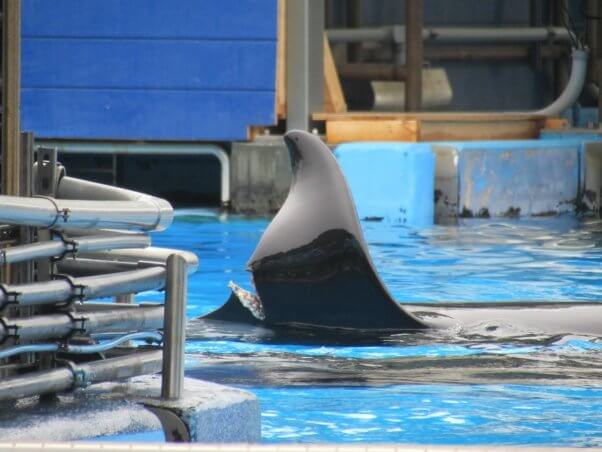
An orca’s dorsal fin contains an extensive network of blood vessels that helps regulate body temperature. While free orcas have been known to survive severe trauma to their dorsal fins—which often occurs when they’re struck by boat propellers—for captive orcas, healing is much harder. Large, open wounds make them particularly susceptible to infections from environmental pathogens, and infections are one of the leading causes of death among captive orcas.
Katina’s wound remained visible long after her injury, a lasting marker of SeaWorld’s failure to protect her.
A Plaintiff in a Historic Fight for Freedom
Katina was not only a victim of SeaWorld’s cruelty—she was also a symbol of resistance.
She was one of five wild-captured orca plaintiffs in PETA’s first-of-its-kind lawsuit asking a federal court to recognize that orcas forced to perform at SeaWorld are being held as slaves in violation of the 13th Amendment to the U.S. Constitution. The historic filing—the first ever to seek application of the 13th Amendment to nonhuman animals—called for the orcas’ release to their natural habitats or to seaside sanctuaries.
Katina’s Life at SeaWorld
Katina’s life of deprivation and death in a tiny tank was not inevitable. SeaWorld could have sent her to a seaside sanctuary, but instead it:
- Confined her for life in concrete tanks
- Used her as a breeding machine
- Housed her in unnatural, dangerous social groupings
- Exposed her to chronic stress
She joins dozens of orcas who have died in extreme captivity—and her loss underscores what marine parks continue to ignore: Orcas do not belong in tanks.
Help Free Corky Now!
While Katina’s life is over, other orcas like Corky remain trapped in SeaWorld’s abusement parks. Corky is confined inside a tiny tank, swimming in endless circles. Her siblings and other members of her pod still swim freely in the ocean, but the only life that Corky knows is one of deprivation, suffering, and loss.
Katina lost her life in a tiny tank. Don’t let Corky suffer the same fate. Tell SeaWorld to send her to a seaside sanctuary before it’s too late.