


PETA’s Push Liberates Animals From Laboratories
The revolution PETA has been driving forward from day one is accelerating: For starters, even though lots of experiments on animals are continuing for now, the US National Institutes of Health (NIH) has begun to shift away from such experiments – a monumental victory, thanks to support from PETA members and years of hard work, including never-ending agitation and the dedication of our scientists.

Pain OUT, Progress IN
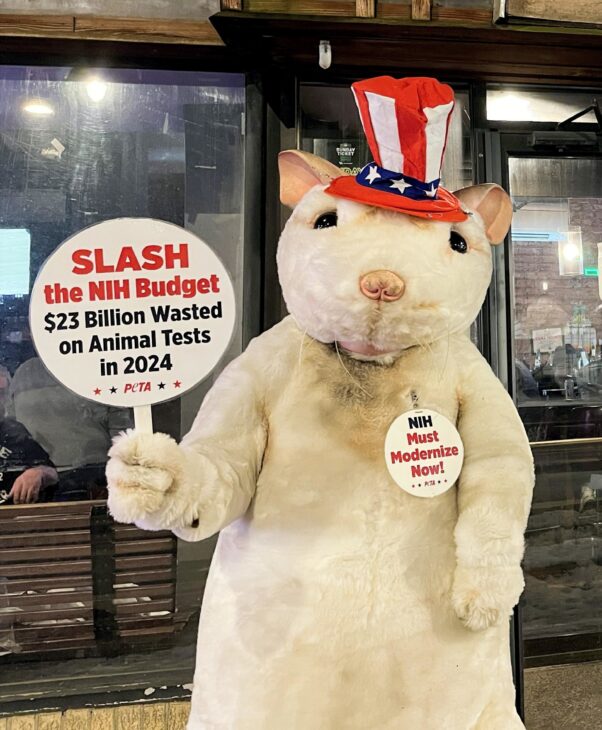
Until now, the agency has squandered nearly half of its enormous budget – about $23 billion every year – on painful and deadly experiments on animals that rarely, if ever, produce any relevant results for human health. That’s changing. Under Director Dr. Jay Bhattacharya, NIH is following recommendations contained in PETA’s Research Modernization NOW plan, including expanding funding, training, and infrastructure for animal-free methods like organs-on-chips and AI and stepping back from funding many studies using animals.
Ending Payouts to Monkey and Beagle Abusers
NIH will stop offering funding opportunities that request researchers to only use animals – which will spare a huge number of animals. It’s also closing its in-house beagle sepsis laboratory and ending some HIV vaccine experiments on monkeys. And remember Harvard experimenter Margaret Livingstone? After PETA campaigned hard to expose the fact that she raked in tens of millions of dollars to torment baby monkeys, including by tearing them from their mothers and sewing their eyes shut, NIH canceled her grant, too. Four decades of misery are over.

Rats and Fish Leaving the Lab
The momentum isn’t limited to NIH. The US Food and Drug Administration (FDA) is starting work to replace tests on animals for monoclonal antibody therapies and other drugs with effective human relevant methods. PETA scientists have been working for this lifesaving change by developing a non-animal approach and presenting it to the FDA. It was supportive of our approach, as was every other government agency to which PETA has presented it worldwide.
“This human-based approach will accelerate innovation, improve healthcare outcomes, and deliver life-changing treatments. It marks a critical leap forward for science, public trust, and patient care.” – NIH Director Dr. Jay Bhattacharya
We’re also driving change in Canada. Following input from PETA scientists, Health Canada and Environment and Climate Change Canada released a strategy for moving away from outdated chemical testing on animals. PETA scientists collaborate with Heath Canada to replace tests on animals, including replacing inhalation tests on animals with nonanimal approaches and publishing a strategy on avoiding lifetime cancer tests on rats and mice.
Everyone Agrees: Stop Experiments Overseas
NIH is making progress but still sends billions of dollars to overseas laboratories that genetically alter cats to have
deformed legs, infect bats with diseases that are fatal to humans, force-feed mice feces, and other horrors. We’re out to stop all this, too, with the CARGO Act – a bill that would prevent any US funding of international experiments on animals. This act is drawing strong bipartisan support in both the US House and Senate, and its four lead sponsors, Republicans Rep. Troy Nehls and Sen. Rick Scott and Democrats Rep. Dina Titus and Sen. Cory Booker, also wrote to NIH Director Bhattacharya, calling on him to adopt these reforms immediately.
Global Momentum
In London, PETA UK’s billboard featuring a caged beagle puppy pleading for his life caught the attention and hearts of Members of Parliament on their way to work. One of them was Irene Campbell, who wrote a powerful opinion piece backing PETA UK’s call for the government to fulfill its pledge to phase out testing on animals and to adopt PETA UK’s Research Modernisation Deal.
And after a briefing from PETA Netherlands, the Dutch House of Representatives voted to phase out government funding for experiments at Biomedical Primate Research Centre – the largest laboratory of its kind in Europe – and invest in cutting-edge, animal-free research. By 2030, not a cent of government funding will go to harming primates!
What You Can Do
Let’s push hard! Please, seize this pivotal moment: Urge your legislators to support PETA’s Research Modernization NOW and the CARGO Act.