
Bloodied Beagles, Sick Monkeys: PETA Urges 12 U.S. Institutions to Examine Ties to Vile Indian Lab
For Immediate Release:
July 10, 2025
Contact:
Tasgola Bruner 202-483-7382
PETA calls on 11 U.S. institutions to scrutinize their business relationships with Palamur Biosciences, an enormous contract laboratory in India, after whistleblowers shared evidence of dogs lying in pools of blood and other unimaginable horrors there in a first-of-its-kind exposé by PETA India.
The exposé prompted a government-appointed inspection of Palamur, which confirmed PETA India’s findings. But India’s animal laboratory oversight body dragged its feet on sanctions for a month, so PETA India sued, alleging an apparent cover-up.
In its July 8 ruling, the High Court of Delhi ordered the Committee for Control and Supervision of Experiments on Animals (CCSEA) to take interim remedial steps against Palamur. The court cited the objectionable findings and recommendations of the inspection report that was submitted to CCSEA on June 17, particularly the company’s handling, housing, euthanasia practices, and veterinary care of animals. The inspection report recommended urgent review of the facility’s registration to breed and experiment on animals and the rehabilitation of the more than 1,200 animals it imprisons.
The court also prohibited Palamur from obtaining or caging any new animals, ordered a new inspection overseen by PETA India, and directed CCSEA to address areas of concern identified and file a new status report within two weeks. Another hearing is scheduled for August 4.
Each of the U.S. institutions below collaborated on studies with or used animals from Palamur involving painful and deadly experiments. PETA has contacted each of the following:
- The University of Texas at Austin – Austin, Texas
- Washington University School of Medicine – Saint Louis, Mo.
- University of California, Davis – Davis, Calif.
- Thomas Jefferson University – Philadelphia, Pa.
- Creighton University Medical Center – Omaha, Neb.
- Mount Sinai School of Medicine – New York City, N.Y.
- Harvard Medical School – Boston, Mass.
- Massachusetts General Hospital – Boston, Mass.
- Moffitt Cancer Center – Tampa, Fla.
- Onconova Therapeutics – Newtown, Pa.
- Pennington Biomedical Research Center – Baton Rouge, La.
“Animals at Palamur Biosciences were roughly handled, left to suffer from bloody wounds, and killed in agonizing ways,” says PETA Vice President of International Laboratory Methods Shalin Gala. “PETA urges all institutions to reconsider doing business with this hellhole, and for the U.S. National Institutes of Health to yank the certificate that allows Palamur to serve as a ‘performance site’ for companies that want to submit animal testing data to U.S. agencies.”
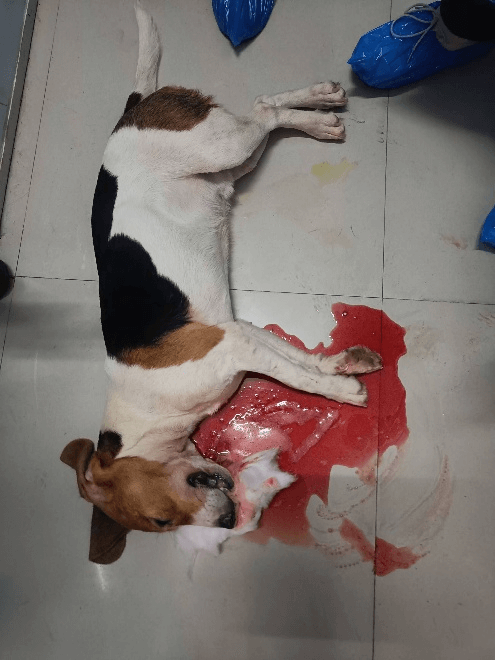
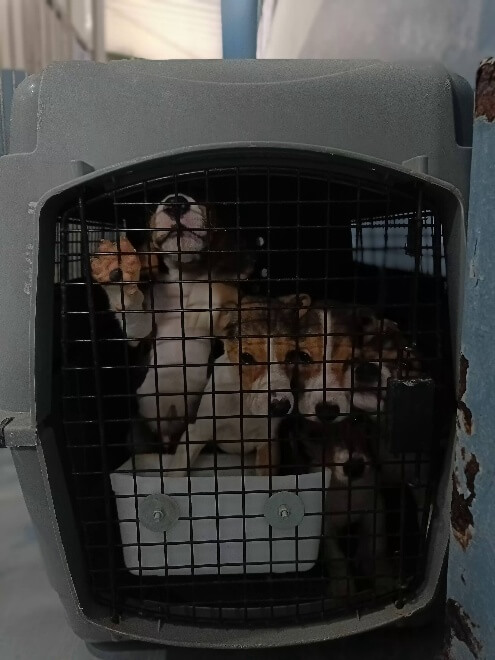
PETA India continues to call for Indian authorities to shut down the laboratory and enforce the government-appointed inspection committee’s recommendation to rescue more than 1,200 animals at Palamur.
PETA India’s exposé included first-hand accounts, photographs, and video from inside Palamur showing widespread agony, squalor, and numerous animal welfare violations, touching off a flurry of activity in response in India and the U.S.:
- Police in India opened a criminal investigation, the first time this has happened for any animal laboratory there.
- Government-appointed inspectors issued an explosive report recommending “immediate regulatory action…including the removal and rehabilitation of animals in order to prevent further pain and suffering” for the facility’s more than 1,200 animals, and a review of Palamur’s registration and breeding license.
- PETA called on the National Institutes of Health to investigate Palamur because it is a U.S. government-sanctioned laboratory and is required to comply with U.S. standards.
PETA India’s groundbreaking exposé detailed:
· Animals suffering from ulcers in their mouths or intestines.
· Staff kicking animals or closing cage doors on their legs, causing fractures.
· Some 1,500 dogs kept in a space designed for about half that number. Three to four dogs occupied cages meant for just two, leading to fights, food aggression, and painful wounds that were not kept clean. Staff did not provide pain management.
· Palamur obtained wild-caught rhesus macaques from a supplier. Some tested positive for dangerous pathogens, likely monkeypox. The company kept the matter quiet despite the health risks and killed the monkeys.
· A minipig got pregnant, and because Palamur did not have a breeding license, staff killed all the piglets without sedation by a painful injection straight into the heart.
In 2024, the U.S. Environmental Protection Agency and Health Canada’s Pest Management Regulatory Agency temporarily stopped accepting studies from Palamur over concerns about the falsification of data following an inspection by the Indian National Good Laboratory Practice Compliance Monitoring Authority.
PETA—whose motto reads, in part, that “animals are not ours to experiment on”—points out that Every Animal Is Someone and offers free Empathy Kits for people who need a lesson in kindness. For more information, please visit PETA.org or follow PETA on X, Facebook, or Instagram.