PETA Investigation Reveals Horrific Conditions at Pseudo-Sanctuary
Update: On January 18, 2006, Carmel “Charlie” Azzopardi, owner of the Amarillo Wildlife Refuge (AWR), was indicted by a federal grand jury on three felony counts and one misdemeanor count of illegal trafficking of endangered animals, including clouded leopards and tigers.
Instead of providing animals with sanctuary, Azzopardi regarded the animals at AWR as nothing more than commodities to be bought, sold, borrowed, and traded. In fact, Azzopardi has regularly advertised animals for sale in The Animal Finders’ Guide, a trade magazine for the exotic-animal industry.
Carmel “Charlie” Azzopardi claims to operate a refuge for rescued animals, but he actually operates within the shabby and often shady world of animal brokers and the cruel animal-training business. He trades and sells exotic animals and adds to the problem of big-cat overpopulation and private ownership of exotic animals by breeding more babies. He uses those young animals in dangerous public photo shoots that various businesses, including the Westgate Mall in Amarillo, allow him to set up on their properties.
A PETA investigator volunteered and worked at Amarillo Wildlife Rescue (AWR) from June until August 2003 and visited the facility numerous times thereafter. She documented the abuse, neglect, and exploitation of the wild animals imprisoned at AWR as well as the wretched conditions in which they were forced to live and die. The animals at AWR were often denied the most basic necessities: wholesome and ample food, water, veterinary care, and clean cages.
Primates in Peril
The indoor chimpanzee cage at AWR was an underground cement pit that resembled a dungeon. Our investigator was appalled when, on her very first visit to AWR, she saw piles of rotten food and feces swarming with flies and maggots in the chimps’ depressing cell. Over time, she found out that this was the usual state of affairs at AWR. The chimpanzees, including one who Azzopardi claims appeared in a remake of Planet of the Apes, spent their days staring at the walls, lying on a garbage-strewn metal resting platform, or screaming and fighting with one another because of the unnatural and stressful conditions.
Walter is an 11-year-old chimpanzee who has been at AWR since he was 9 years old. Evidence indicates that Walter’s name before coming to AWR was Bucky, and at the time of PETA’s 1994 investigation into animal supplier Buckshire in Perkasie, Pennsylvania, he was just 2 years old. Bucky was born in 1992 at the Laboratory for Experimental Medicine and Surgery in Primates (LEMSIP) at New York University. LEMSIP had an ugly habit of giving babies to Buckshire in exchange for using other Buckshire chimpanzees for breeding and testing. LEMSIP tore Bucky from his mother and gave him to Buckshire, and from there, at 7 months of age, he was given to a tawdry traveling photo business run by a Florida couple. Bucky was returned to Buckshire’s basement laboratory cages when he was 2 years old. That’s when PETA’s investigator videotaped Bucky rocking ceaselessly from loneliness and the trauma of losing his mother.
PETA’s investigation resulted in U.S. Department of Agriculture (USDA) sanctions against Buckshire for violations of the federal Animal Welfare Act. Two of those violations resulted from keeping chimpanzees in cages that did not meet the 5-foot-by-5-foot minimum size (imagine living in an area that size for decades!) and Bucky’s obviously sorry mental state. After the USDA sanctions, Buckshire sold many of the chimpanzees held in its basement. Bucky was among them. It took several years for PETA to pick up on Bucky’s trail, but we found him at Steve Martin’s Working Wildlife, an animal dealer and exhibitor in California who trains exotic animals for commercials and movies. And that’s where the trail ended until our investigation of AWR, where we found Bucky once again, having been handed off to yet another miserable place. Our investigator visited Martin’s animal-training camp in California after leaving AWR. She observed two tiger cubs who she was told had been born at AWR and turned over to Martin’s Working Wildlife to be trained to be animal stars. They were on chains held by two women who confirmed that Walter and Bucky were one and the same.
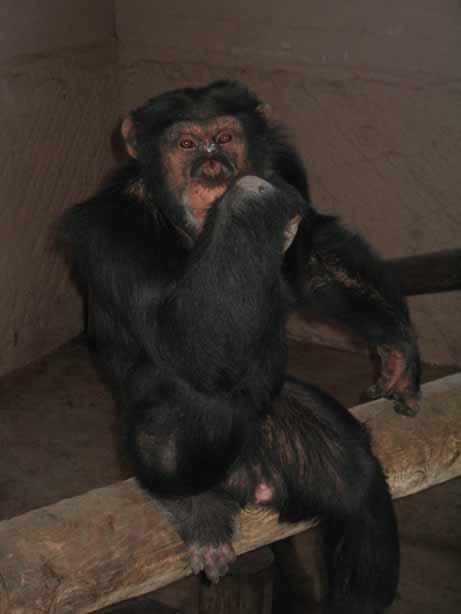
The information on AWR’s web site changes frequently, but here’s what the front page of Azzopardi’s web site said about Walter/Bucky last summer: Walter, a 9-year-old chimpanzee, also lives at the refuge. He was only one of the many animals adopted by the refuge when their owners no longer wanted them as pets. Here’s what Azzopardi said about Walter/Bucky on the web site’s bio page (he couldn’t even get his lies straight): You’ve probably seen him in a few Hollywood movies but now Amarillo is his home. Walter was a sitcom star in Germany and he spent two years performing in Public Broadcast System shows for children. Actor Steve Martin was one of his supporters. When Walter retired from show biz he was given to a traveling petting zoo. He lived in a small cage, four foot by thirty inches across and three feet high. Charlie Azzopardi then bought Walter and brought him to Amarillo where he lived in Charlie’s garage while his new home was built at the Amarillo Wildlife Refuge.
Among other unfortunate rescues at AWR was an overweight chimpanzee named Alex, who suffered from a chronic cough and infected wounds that oozed green pus. Alex died suddenly in August 2003, but Azzopardi didn’t even bother to have Alex’s body examined to determine the cause of his death so as to rule out diseases that might be contagious to the other chimpanzees. Alex is the lucky one. Bucky/Walter may have many more decades of misery ahead of him if he is not removed from AWR.
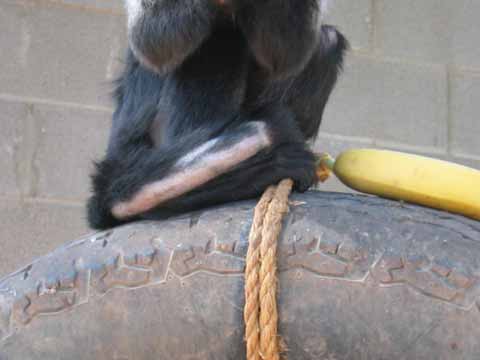
Our investigator also saw capuchins, spider monkeys, and gibbons living in tiny, filthy enclosures that were swarming with insects, where clouds of flies and wasps contaminated their food and made it inedible. Like the chimpanzees, all these primates were forced to eat a deficient diet of dog food that Azzopardi got through donations from a local business, even though he drives a Mercedes, owns a private plane, and lives in a beautiful house.
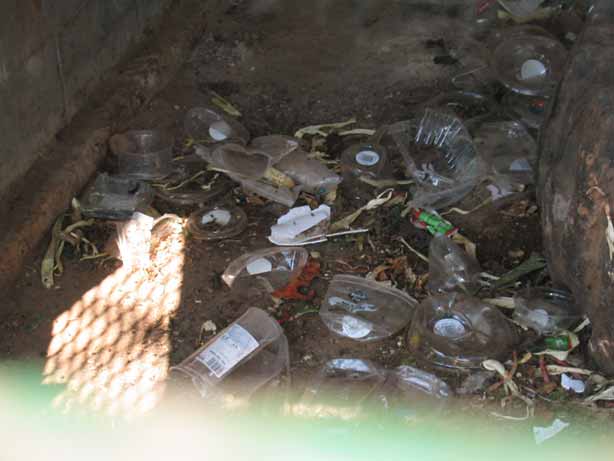
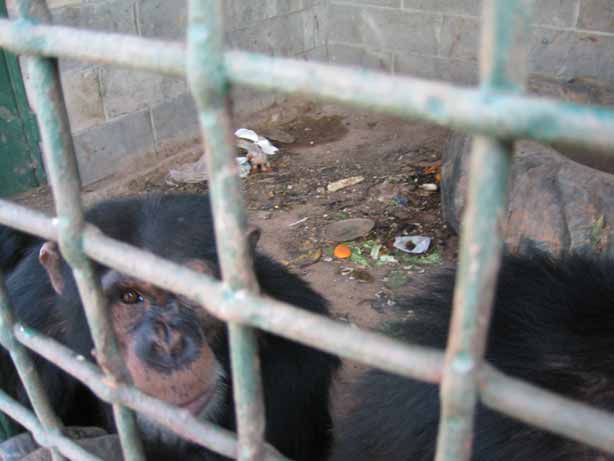
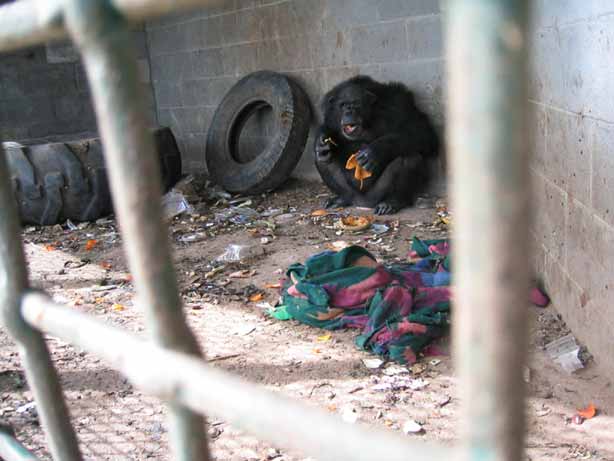
Although federal law says that primates must be provided with psychological enrichment, the mental anguish of a capuchin named Delilah manifested itself in a self-injurious behavior known as hair plucking. As for the required psychological enrichment, our investigator was told that entries in the primate-enrichment log book (which must be presented to the USDA during inspections) were fabricated.
Tiger Tales
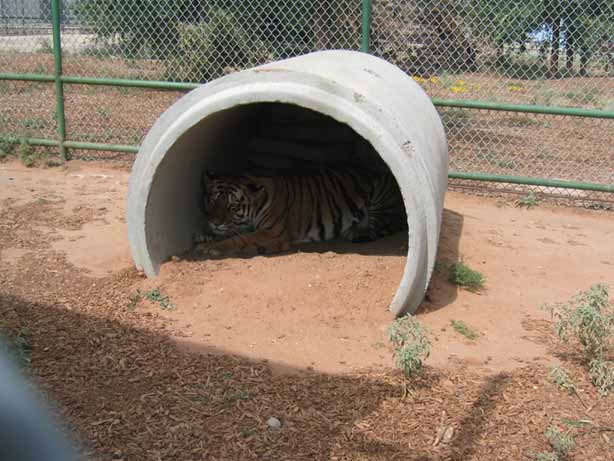
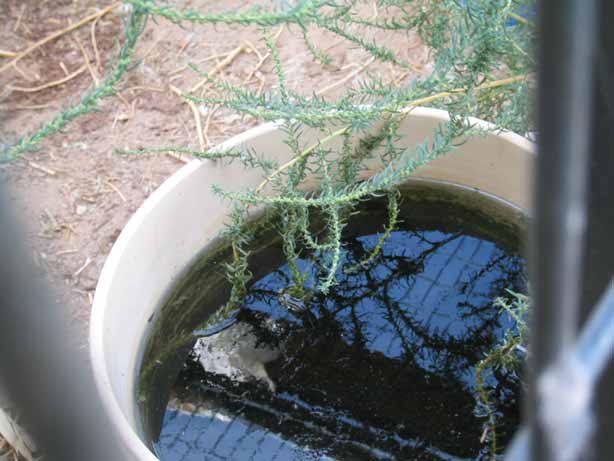
Tigers and other big cats were housed in small enclosures with nothing more than a cinderblock box or concrete culvert to shield them from the blazing sun and temperatures of 100F or more. As in the primates’ cages, rotten food and feces routinely sat in the big-cat enclosures for days and even weeks at a time, and algae grew in the water receptacles, which were rarely cleaned. None of the cats were provided with enrichment.
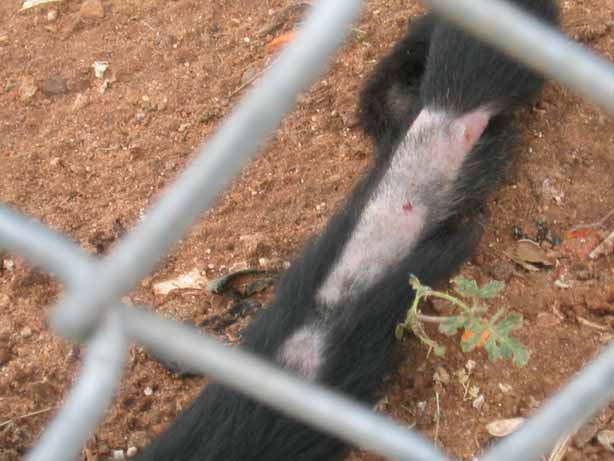
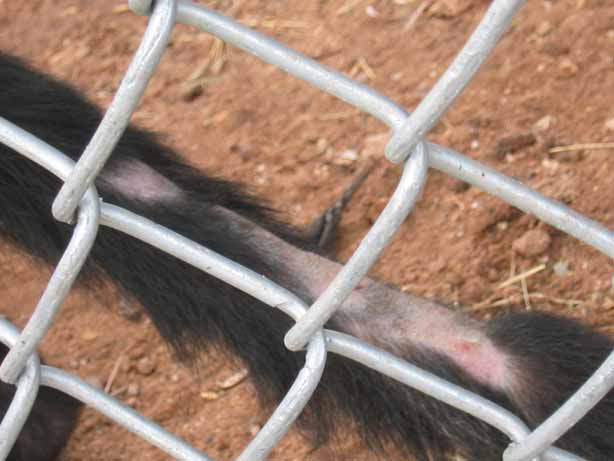
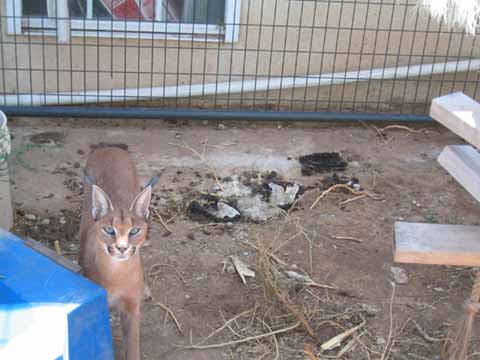
A pair of caracals (large sleek cats with short auburn-colored fur and pointed, black-tipped ears) kept in a giant bird cage endured particularly bad conditions. Azzopardi claimed that the cats were too aggressive to be removed from their cage when it was cleaned, but the truth was that there was not an adjacent enclosure in which to put the cats! As a result, half-eaten animal parts, feces, and piles of rotten, maggot-filled meat littered the cage. The USDA inspectors had to have noticed this perpetually filthy enclosure during inspections, yet they did nothing about it. Another big cat who suffered neglect was a tiger who had a raw, bloody wound on her tail. Instead of providing the animal with veterinary treatment, Azzopardi placed this tiger in an enclosure with a tiny pool of dirty water in it with the fantastical expectation that the filthy water would somehow help heal the animal’s tail.
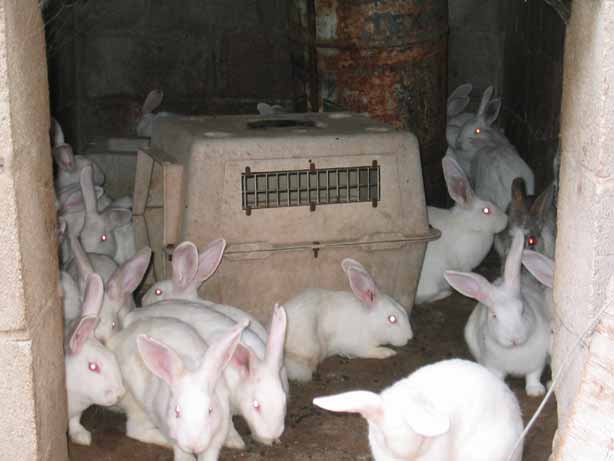
One day, with Azzopardi’s permission, a rabbit breeder dumped several hundred unwanted rabbits at AWR. Many arrived with injuries. The breeder told our investigator that he had beaten them with a hammer to get them out of their cages and into the transport crates, which were already crammed full of rabbits. Many of the animals died at AWR. The sick were denied veterinary care, and Azzopardi turned some into stew.
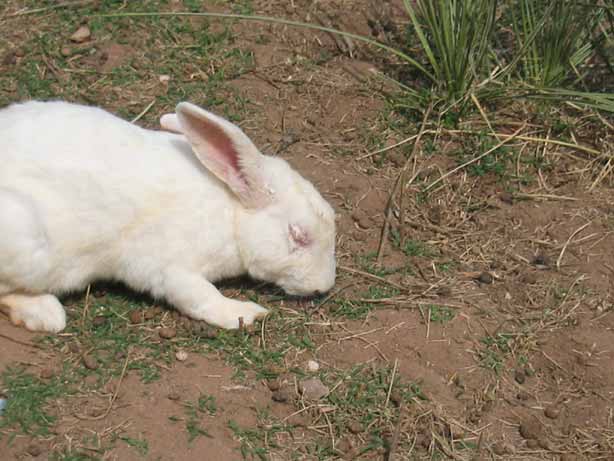
The survivors were forced to live in filthy, overcrowded cages. On videotape, Azzopardi is heard telling our investigator and an AWR volunteer that rabbits enjoy living in their own waste. Still others were left to wander the property looking for food; some suffered from untreated eye ailments; and several were discovered dead inside the big-cat enclosures. During one incident, our investigator watched helplessly as caracals tried to pull a rabbit into their enclosure. The rabbit eventually broke free, but she had been torn open and was in shock; our investigator rushed the wounded animal to a veterinarian who put her out of her misery.
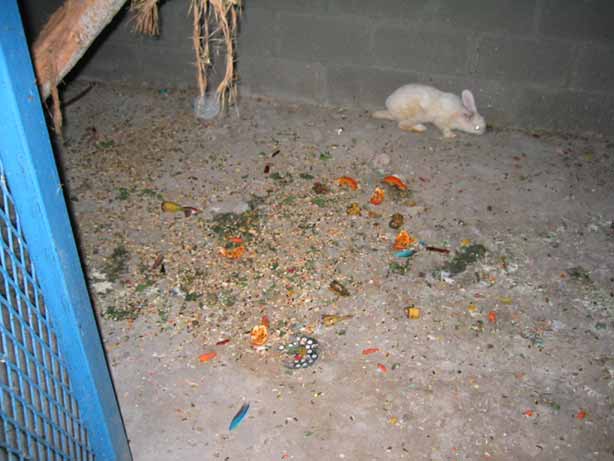
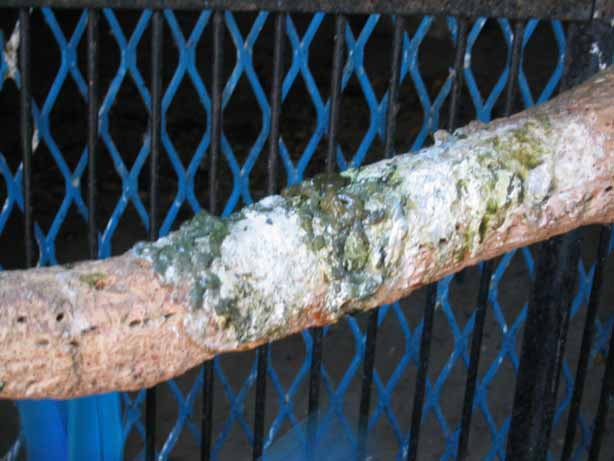
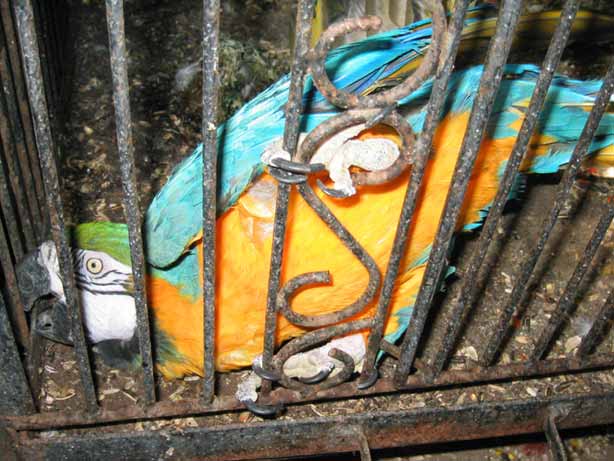
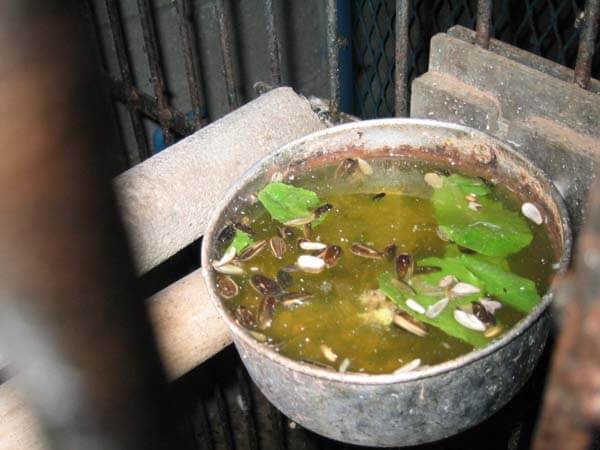
Despite the dangers associated with cross-species contamination, a variety of birds, including canaries, parrots, and cockatiels, shared a room with the capuchin monkeys. In addition to the loud and disturbing noises made by some of the birds, the capuchins were forced live next to bird cages in which feces, rotten food, and maggots were inches thick. As if this weren’t bad enough, Azzopardi instructed our investigator to pick out the uneaten seeds that had fallen into this mess and place them back in the birds’ food receptacles!
The Raptor Factor
As a result of information provided by PETA, the U.S. Fish and Wildlife Service charged Charles Azzopardi with multiple violations of the federal Migratory Bird Treaty Act to which Azzopardi pleaded guilty. He was placed on six months’ probation, and an inspection provision was placed on his probation, granting state and federal officials the authority to inspect his facility. A $4,200 fine levied against Azzopardi was suspended.
Azzopardi illegally accepted and kept in his possession eight raptors, including hawks, falcons, kites, and an owl, all of whom are protected under the Migratory Bird Treaty Act.
The first birds our investigator documented were three young kestrels who had been brought to AWR by a local member of the public. While all three kestrels were healthy and able to fly, they were confined to one small cage filled with maggots, feces, and rotten meat. At the insistence of Azzopardi and despite our investigators repeated efforts to provide them with a proper diet, the young birds were maintained on a diet of hamburger. According to Azzopardi, the raptor food available at the local PETsMART (which costs $19 for two bags) was too expensive. Eventually, the kestrels went missing, apparently having escaped through the wire openings of their cage.
Despite suffering from a broken wing, an adult Mississippi kite brought to the facility by an AWR volunteer was never provided with veterinary care. This kite was kept in a “pet” carrier (with maggots, feces, and rotten meat, although kites are primarily insectivores) before being placed in a flight cage. Our investigator later found the remains of what appeared to be the same bird near the area where the dogs from the facility congregated.
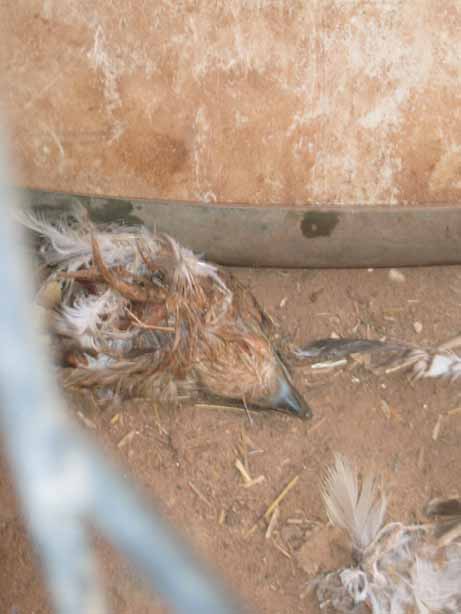
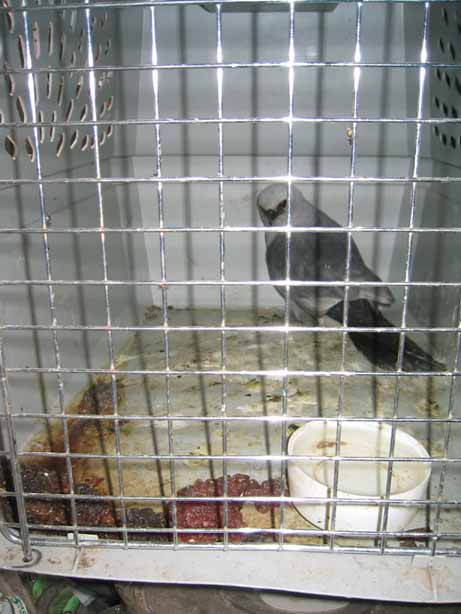
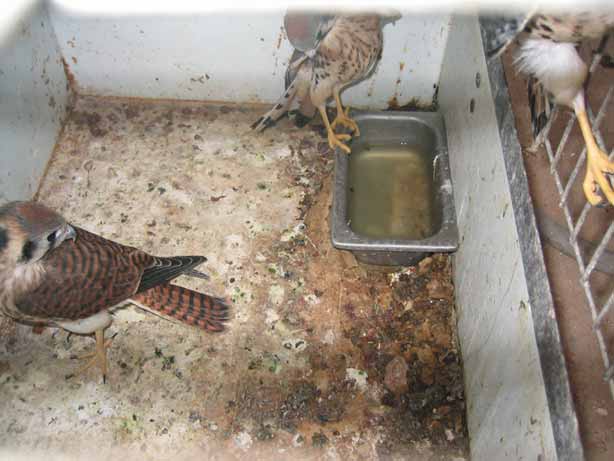
Not long thereafter, two hawks and one kite arrived at AWR (on three separate occasions). The first hawk to arrive was a baby who had been illegally taken from her nest by someone who had ultimately decided not to keep her as a pet. The second to arrive was a slightly older hawk from the Amarillo Zoo who had reportedly been attacked by rock-throwing kids. The third to arrive was a kite with a broken wing who was brought to the facility by a member of the public. Once again, none of the birds was provided with a proper diet or veterinary care. As a result, the birds were weak and unable to stand correctly. The baby hawk, who eventually grew into a juvenile, was later found torn to shreds after she had apparently wandered into one of the big-cat cages.
Breeding for Greed
As animals such as chimpanzees and tigers grow older, they become impossible to handle safely. At facilities like AWR, these older animals are bred to provide baby animals to use in lucrative photo shoots at shows and in malls, as well as for television and film contracts.
In less than four months, Azzopardi bred and stole from their mothers seven baby animals: six 5-day-old tigers and an infant gibbon. Azzopardi also advertises white tiger cubs for sale in a publication that peddles exotic animals to private owners, breeders, dealers, and trophy hunters. AWR’s web site falsely implied that white tigers are in danger of extinction when, in fact, white tigers are not a species of tiger at all; they are an aberration caused by inbreeding, easily bred by people like Azzopardi, who prey on the public’s naiveté.
In one heart-wrenching scene captured on videotape, a lone mother gibbon in a barren cage hugs her newborn baby close to her chest, calling out in distress as Azzopardi fires sedation darts at her through a blow gun despite the risk of hitting the baby in the head. Torn from the comfort of his mother’s arms, the baby screamed, flailed, and cried incessantly. Days later, our investigator found him clinging to a small stuffed animal in the corner of a tiny, dark cage in Azzopardi’s kitchen, where he had been left alone, crying for food. Not long thereafter, the baby gibbon, whose name was Tonga, was exhibited in a bird cage in a mall and taken to an AWR volunteer’s lamp shop, where he was kept in a hanging bird cage in the middle of the store. Tonga was passed around and touched by almost 30 schoolchildren, paralyzing him with fear and causing him to urinate uncontrollably. Within a few weeks, he was used in a photo shoot, during which he was grabbed and held by even more strangers. At the shoot, Tonga was kept in the same enclosure as a tiger cub!
Another baby animal torn from his mother and forced to spend many hours posing for photographs in malls and parking lots was a tiger named Ziggy. Naturally rambunctious and full of energy, Ziggy routinely nipped and clawed at his handlers and tried to do the same to children who were taking part in the dangerous photo shoots. Video shows volunteer assistants roughly handling Ziggy to disorient him in the hopes of making him less likely to injure one or more of the dozens of shoppers who had paid to have their photographs taken with him. Despite, or perhaps because of, Ziggy’s mishandling, on at least two occasions the agitated tiger cub tried to sink his teeth into the legs of the kids with whom he was being photographed. Little did the parents of the children (some of whom were younger than 4 years old) know that bites or scratches from tigers can cause blood infections. Our investigator contracted a blood infection from a tiger scratch and had to be treated for several days with intravenous antibiotics.
After Azzopardi forced Ziggy to work a six-hour photo shoot in the blazing-hot parking lot of a local business in Amarillo, the cub developed painful blisters on his feet from standing on the hot pavement all day. It was not uncommon for some animals at AWR to be denied veterinary care and fed late or not at all because they had been used for photo shoots all day. Azzopardi sometimes made thousands of dollars a day at the photo shoots, but he told our investigator that he could not afford to pay her to work as an animal keeper because his ex-wife had cleaned out AWR’s bank account.
Azzopardi gave a baby tiger named Apollo to the pathetically substandard Corpus Christi Zoo as a replacement for another “defective” baby tiger the zoo had purchased from AWR. The zoo had complained that the first tiger cub was cross-eyed. The U.S. Department of Agriculture charged the Corpus Christi Zoo with such serious violations of the federal Animal Welfare Act that the zoo’s exhibitor license was revoked, and it was forced to get rid of all its animals. What has become of Apollo or the “defective” cub is anyone’s guess.