Animals Used for Experimentation
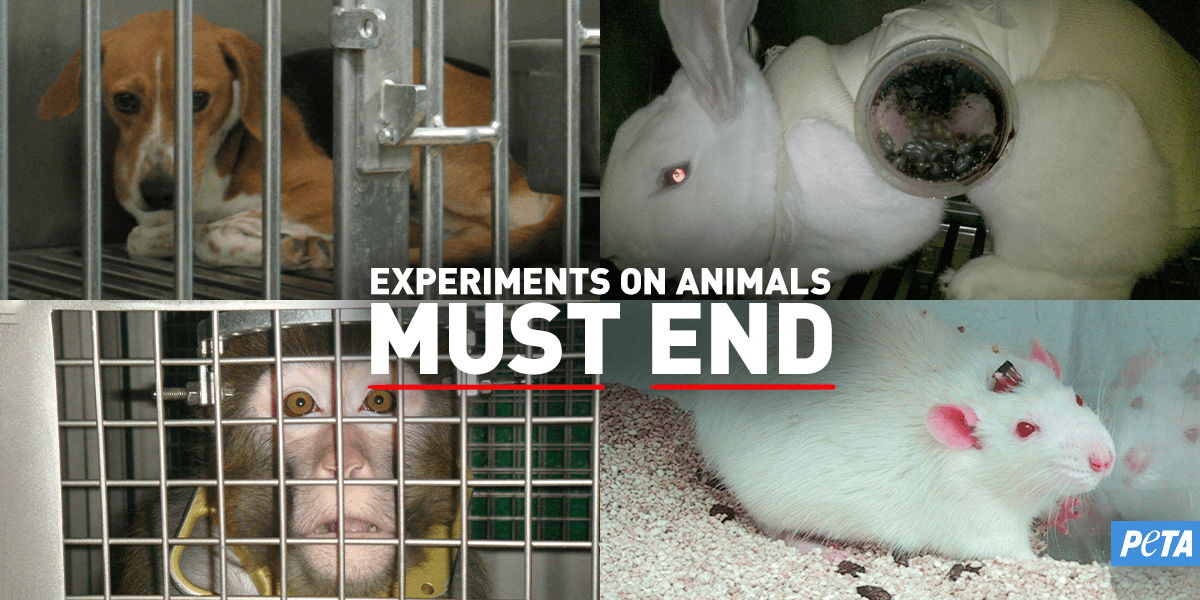
Right now, millions of mice, rats, rabbits, primates, cats, dogs, and other animals are locked inside cages in laboratories across the country. They languish in pain, ache with loneliness, and are deprived of everything that’s natural and important to them. All they can do is sit and wait in fear of the next terrifying and painful procedure that will be performed on them. A lack of environmental enrichment and the stress of their living situations cause some animals to develop neurotic behaviors, such as incessantly spinning in circles, rocking back and forth, pulling out their own fur, and even biting themselves. After enduring lives of pain, loneliness, and terror, almost all of them will be killed.
How PETA Helps Animals in Laboratories
Since PETA’s inception and the landmark Silver Spring monkeys case, we’ve been at the forefront of exposing and ending experiments on animals. Our scientists, campaigners, researchers, and other dedicated staff work hard to persuade universities, hospitals, contract laboratories, other companies, and government agencies to abandon animal tests and embrace modern, non-animal methods.
Two teams lead PETA’s efforts to end tests on animals. Our Laboratory Investigations Department focuses on ending the use of animals in experiments not required by law, and our Regulatory Toxicology Department focuses on replacing the use of animals in tests required by law with human-relevant, animal-free toxicity testing approaches. With help from supporters like you, these teams and other hardworking staff at PETA win numerous victories for animals imprisoned in laboratories every year. Here’s how they do it:
- Promoting PETA’s Research Modernization Deal, the first comprehensive, science-backed plan to phase out tests on animals
- Conducting groundbreaking eyewitness investigations and colorful advocacy campaigns to shut down laboratories and areas of animal experimentation
- Filing groundbreaking lawsuits to challenge public funding of wasteful, cruel animal experiments
- Working with members of Congress to enact laws to replace animals in laboratories
- Persuading government agencies to stop conducting and requiring experiments on animals
- Encouraging pharmaceutical, chemical, and consumer product companies to replace tests on animals with more effective, non-animal methods
- Ending the use of animals in experiments at colleges and universities
- Helping students and teachers end animal dissection in the classroom
- Developing and funding humane non-animal research methods
- Publishing scientific papers on reliable non-animal test methods and presenting them at scientific conferences
- Hosting free workshops and online seminars to share information about animal-free toxicity testing methods
- Urging health charities not to invest in dead-end tests on animals
How Animals Are Exploited in Laboratories
More than 110 million animals suffer and die in the U.S. every year in cruel chemical, drug, food, and cosmetics tests. They also experience this fate in medical training exercises, curiosity-driven experiments at universities, classroom biology experiments, and dissection even though modern, non-animal methods have repeatedly been shown to have more educational value, save teachers time, and save schools money. Exact numbers aren’t available, because mice, rats, birds, and cold-blooded animals—who make up more than 99% of animals used in experiments—aren’t covered by even the minimal protections of the federal Animal Welfare Act and therefore go uncounted.
Examples of chemical and toxicity tests on animals include forcing mice and rats to inhale toxic fumes, force-feeding dogs chemicals, and applying corrosive chemicals into rabbits’ sensitive eyes. Even if a product harms animals, it can still be marketed to consumers. Conversely, just because a product was shown to be safe in animals doesn’t guarantee that it will be safe to use in humans.
Much product testing conducted on animals today isn’t required by law. In fact, a number of countries have implemented bans on the testing of certain types of consumer goods on animals, such as the cosmetics testing bans in India, Israel, New Zealand, Norway, and elsewhere.
Meanwhile, at universities and other institutions, experimenters inflict suffering on and kill animals for little more than curiosity’s sake—even though the vast majority of their findings fail to advance human health. They tear baby monkeys away from their mothers, sew kittens’ eyes shut, mutilate owls’ brains, puncture the intestines of mice so that feces leak into their stomachs, and terrorize songbirds with the sounds of predators. At the end of experiments like these—which consume billions in taxpayer funds and charitable donations each year—almost all the animals are killed.
Animal Experiments Throughout History: A Century of Suffering
PETA created an interactive timeline, “Without Consent,” featuring almost 200 stories of animal experiments from the past century to open people’s eyes to the long history of suffering inflicted on nonconsenting animals in laboratories and to challenge them to rethink this exploitation. Visit “Without Consent” to learn more about harrowing animal experiments throughout history and how you can help create a better future for living, feeling beings.
Advancing Science Without Suffering: Animal-Free Testing
Testing on animals has been a spectacular failure that has resulted in the loss of trillions of dollars and has cost the lives of innumerable humans and other animals. Experiments on one species frequently fail to predict results in another. Even the National Institutes of Health, the world’s largest funder of biomedical research, acknowledges that 95% of all drugs that are shown to be safe and effective in animal tests fail in human trials.

Technologically advanced non-animal research methods—such as those using human cells, computational models, or clinical studies—can be used in place of animal testing. These methods are more humane, have the potential to be faster, and are more relevant to humans.
Scientists in PETA’s Science Advancement & Outreach division, a part of the Laboratory Investigations Department, have developed a roadmap to phase out failing tests on animals with sophisticated, animal-free methods. Their Research Modernization Deal has gained the support of scientists, medical doctors, members of Congress, and thousands of others who care about ethical and effective science.
How You Can Help Animals Used in Experiments
Each of us can help prevent the suffering and deaths of animals in laboratories. Here are a few easy ways to get started:
- Sign up for PETA’s Action Team to be alerted when protests are taking place in your area.
- Urge your members of Congress to support PETA’s Research Modernization Deal.
- Search PETA’s Beauty Without Bunnies database to ensure that you’re buying only cruelty-free products.
- Donate only to charities that don’t experiment on animals.
- Request alternatives to animal dissection at your school.
- Call on your alma mater to stop experimenting on animals.
- Share information about animal experimentation issues with your friends and family—and invite them to join you in speaking up for animals.