Written by Alisa Mullins
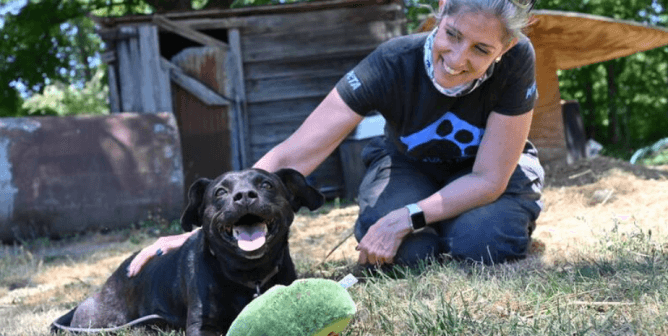
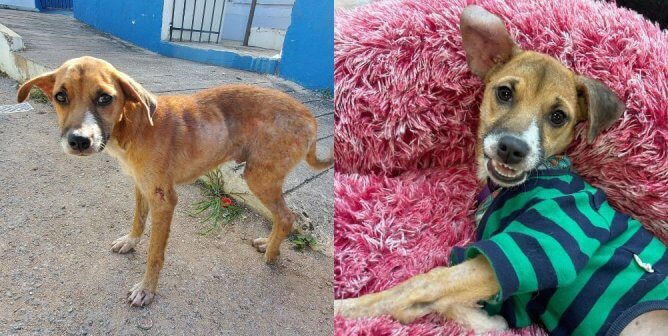
Janice and her son, Jayke, didn't know where else to turn. Penelope, a dog they had adopted from an animal shelter, had gotten out of the yard, been hit by a car, and had injured her right front leg so severely that it dangled uselessly, all nerve sensation lost. Although she had been treated by a veterinarian after the accident, there was nothing more that could be done for her permanently nerve-damaged leg.
Unable to use the numb limb, Penelope simply dragged it around, and it quickly became covered with bleeding sores. The only solution was amputation, but Janice is a single mother on a limited budget who couldn't afford the surgery. Heartbroken, she and Jayke were faced with euthanizing their otherwise healthy, happy dog.
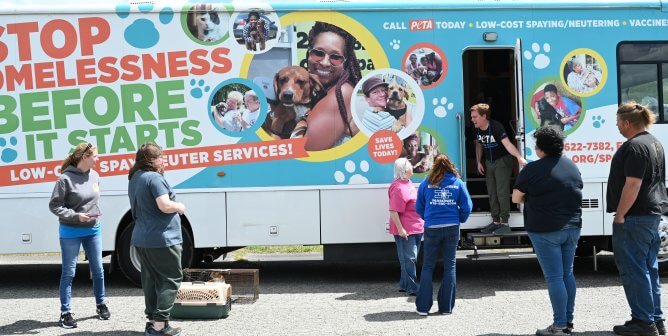
In a letter to the editor of the local newspaper, Jayke describes what happened next: "Finally, I called PETA to see if they could help. They agreed to do the amputation in their mobile clinic and worked with us to make the cost manageable—about a tenth of what I had been told by the vet it would cost me. They saved my Penelope's life and helped us when no one else would. I am forever grateful to PETA for all they have done."
Happy to oblige! We're just glad that Penelope is on the road to recovery and back to greeting Janice and Jayke at the door with her signature hugs, albeit minus an "arm."
What You Can Do
Please support PETA's no-cost to low-cost mobile spay/neuter clinics, which also provide low-cost vaccinations, flea treatment, and the occasional emergency surgery. Because the clinics offer services below cost, they operate at a loss and therefore rely on donations to keep the doors open and the wheels rolling.
Written by Michelle Kretzer
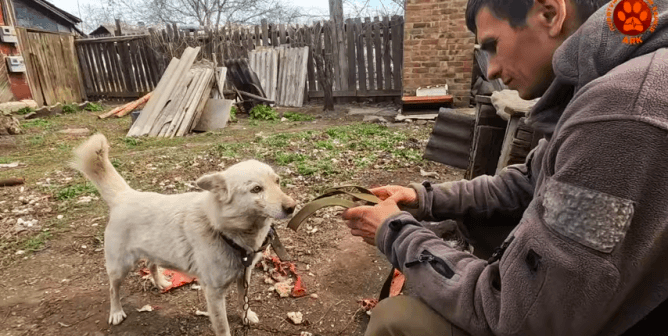
A driver in southern Georgia was shocked when she spotted a pitiful-looking dog hanging on for dear life to the top of a crate in the back of a pickup truck that was careening down the interstate. A heavy chain around the animal's neck that was hooked to the top of the crate looked as if it could have choked the dog, but it may well have been the only thing that kept the pup from flying onto the asphalt as the truck whizzed in and out of traffic.
Thinking quickly, the woman immediately got behind the truck and snapped pictures of the dog and the vehicle's license plate. She was shocked to see that the dog was underweight, covered with wounds, and wearing a hunting vest. As soon as she got home, she contacted PETA and forwarded the pictures to us.
PETA's Emergency Response Team traced the license plate to a county in Florida, a state that has a law against transporting animals inhumanely. Forcing a dog to try to hang on for fear of falling out of a speeding vehicle certainly qualifies, so PETA shared the evidence with law-enforcement officials without delay.
In no time, officers were knocking on the teenage driver's door. He admitted that he had used the dog for hunting and then chained the animal in the back of the truck. The teen agreed to turn over the dog as well as five others and was sentenced to 150 hours of community service. The officers took the dogs to a local animal shelter, where they have been put up for adoption.
If you ever see an animal being cruelly transported in the back of a pickup truck, alert authorities. Even if it isn't specifically illegal in your area, you can still ask police to intervene, arguing that not only does it jeopardize the animal's safety, other drivers on the road could also be seriously injured or killed if the dog fell out and caused an accident.
Written by PETA
Noooo! How does it happen every year? Mother's Day is just six days away, and all you've got prepared for dear old Mom is an impromptu poem on the phone. Or the old standby, flowers. But does it have to be that way? Noooo!
iStockPhoto.com/dickysingh
Here are some gifts that will delight your mom while helping other moms:
It's the one holiday when we get to celebrate Mom for all that she's done for us, so show your appreciation by honoring all moms, from feathered to finned!
PETA gets requests from people for free doghouses for dogs of all shapes and sizes. But when our fieldworker laid eyes on 7-pound Chloe, she did a double take: This little dog was chained up outside!
Unable to bear the thought that the tiny Chihuahua would spend the rest of her life outdoors simply because her guardians said that they couldn't housetrain her, our fieldworker decided something had to give. Small short-haired dogs like Chloe are especially susceptible to hot and cold weather, so she would be miserable outside. She might not even survive the upcoming hot summer months.
What a relief that Chloe's family agreed that she would be safer and happier indoors. When we ran an adoption ad, we heard from a sweet woman who had recently lost her Chihuahua because of complications from diabetes. Since our potential adopter described herself as a retired, "stay-at-home dog mom" able to housetrain her properly, we knew Chloe was in luck.
Sure enough, Chloe has mastered housetraining in her new home and is sticking to her new mom like glue, even claiming a satin pillow on the couch as her special spot. Sounds like the magnet on her new mom's refrigerator that reads, "I'm owned by a Chihuahua," isn't far off base.
Written by Jeff Mackey
Washington resident Alba Suarez—a parent, nurse, former teacher, and PETA member—has sent a letter to the head of the state's PTA regarding its announced partnership with McDonald's to "promote healthy eating for kids."
No, this isn't a belated April Fool's joke.
Suarez's letter asks the group to shelve the partnership since it sends the message that the PTA endorses the fast-food giant's fat-, cholesterol-, and sugar-laden foods—the type of foods linked to diabetes, heart disease, and the childhood-obesity epidemic—not to mention the cruel factory-farming practices used by McDonald's suppliers. As Suarez explains in her letter, "Despite the revenue from the partnership, I urge you to consider its true long-term cost—the promotion of unhealthy and inhumanely produced foods to our children."
How You Can Help
Our children deserve better than to be sold (and sold out for) harmful animal products. Please join Alba Suarez and PETA in asking the Washington State PTA to drop its partnership with McDonald's, and be sure to start your own kids on a lifetime of good health and compassionate action by choosing vegan foods for your family.
As we mentioned recently, the EU has issued a ruling that upholds its ban on products from the bloody annual Canadian seal massacre. Now the only remaining challenge to that ban rests with the World Trade Organization (WTO), which just concluded its hearings—with PETA in attendance—and things didn't go well for Canada.
During the hearings, the EU demonstrated that it is not possible to ensure that the seals are unconscious when they are killed. Canada tried to argue that seals decimate cod populations (which local fishers want for themselves), but the EU pointed out that science has shown that the decline of fish populations can be blamed on reckless overfishing.
In the end, if the hearings weren't so important, they might have seemed like a bad joke: Canada succeeded only in calling attention to its own marine mismanagement. This may finally sound the death knell for Canada's seal slaughter, since even its one-time supporters have acknowledged that it has become untenable. We'll keep you posted here at The PETA Files.
Thanks are due to all the good folks who expressed their concerns to the WTO on behalf of PETA or PETA UK, including Jude Law, Pamela Anderson, Joan Jett, Iggy Pop, and Sarah McLachlan. They asked the organization to uphold the ban and/or urged the WTO to hold open hearings—which it did, making it possible for a PETA representative to be present.
The end is in sight, but we can't slack off now—please tell Canadian officials that it's time to stop the slaughter, and then spread the word to get more people involved today.
After he heard about the deadly experiments that the University of Wisconsin–Madison is performing on cats, Randall made a video against it that is so convincing that it could make even the honey badger care.
Randall's buddy Bret Lockett of the New York Jets gave animals an awesome shout-out, too, during an interview with Integral Yoga Magazine:
I don't believe in torturing animals. I've been doing a lot of research and found out about a lot I didn't know, so I joined PETA's 'Ink, Not Mink' ad series urging others to show off their unique tattoos rather than wearing fur. Having played football in New England, where winters are harsh, I knew firsthand that there was no excuse—not even weather extremes—for wearing fur and that there are plenty of other fashionable, warm materials to wear that weren't made by harming animals. I challenged my fans to watch PETA's undercover video footage of fur farms, just like I did. I wanted everyone to know that, for every fur coat, collar or piece of trim, millions of foxes, minks, coyotes, rabbits and even cats and dogs were violently killed with wire nooses. Many of these animals are even skinned alive. The only way to combat this cruelty is by never buying or wearing fur or fur trim.
Bret would likely be pleased with Glamour UK's pick for the best-dressed celebrity: Fervently fur-free Kristen Stewart tops the magazine's list for the second year in a row.
And Perez Hilton graced us with a gallery of the best-undressed celebs: 30 of PETA's hottest nude anti-fur ads.
In the same spirit, here's our gallery of the best celebrity tweets of the week:
Pamela Anderson probably gets asked out via Twitter and other means every day. But she's offering to take a certain fellow out to dinner. Who's the lucky guy? Philippine President Benigno Aquino III. Pam wants to talk to the bachelor president about helping to get Mali, the 39-year-old ailing elephant who is alone in the Manila Zoo, transferred to a sanctuary in Thailand.
Fellow screen icon and animal rights campaigner Brigitte Bardot is making another man an offer he shouldn't refuse. Brigitte joined PETA UK's campaign to get British retailer Fortnum & Mason to stop selling vile foie gras, with a letter to the store's managing director, Ewan Venters, that said, in part, "Tradition is never an excuse for animal cruelty."
You would probably never catch Vanessa Hudgens eating foie gras, but you would catch her grabbing lunch at North Hollywood's Lotus Vegan restaurant.
Where else can you catch your favorite celebs? Tweeting with PETA.
Benjamin Coultier was just 24 years old when he was mauled to death by a frustrated captive bear. He was cleaning the animal's cage as part of his job at Animals of Montana, a company that rents out wild animals for photo shoots as well as film and television productions.
iStockphoto.com/Enter6
PETA had asked the Occupational Safety and Health Administration (OSHA) to investigate because it appeared that the company's owner, Troy Hyde, had allowed his employees to be in direct contact with the animals, in violation of federal workplace-safety laws. Following PETA's request, OSHA found that Hyde had twice violated the law. He had Coultier clean the bear's cage without first moving the animals to a holding pen, which directly resulted in the young man's death, and he failed to report the attack promptly after it occurred. An investigation by state officials uncovered more problems at Animals of Montana, including numerous unreported escapes and an attack on an employee by a mountain lion. The employee sustained a gash in his head that went all the way to his skull, but Hyde reported it as a "scratch."
OSHA wants to see Hyde pay the maximum penalty for a small company, a $9,000 fine. It would be a small measure of justice for the man who lost his life and the bear who was gunned down after the attack.
If you have witnessed unsafe or inhumane conditions at a live-animal attraction or photo opportunity, please let PETA know.
To drum up business, The Brandywine Zoo in Wilmington, Delaware, is holding a contest to name its two newly acquired North American river otters. So PETA is submitting our top choices for names that we think are otterly appropriate: "Crave" and "Freedom."
wwarby | cc by 2.0
Since the zoo bills itself as an educational facility, our names will help teach visitors that animals belong in nature, not in small enclosures for the rest of their lives. As we pointed out in our letter to zoo officials, "North American river otters are highly mobile and regularly travel up to 26 miles a day. In captivity, their range is measured in feet, not miles. North American river otters are very social and commonly establish large, enduring social groupings. At The Brandywine Zoo, these otters will have only each other for companionship."
We wrote to the zoo to suggest our names because staff members have already narrowed down the options to three pairs of names that people can choose from—for $1 per vote. Considering how the zoo is already cashing in on the new otters, perhaps another appropriate pair of names would be "Meal" and "Ticket."
Educators in Flushing might be blushing today. Public School (P.S.) 244 in that Queens neighborhood in New York did something royally kind to animals by becoming the country's first all-vegetarian traditional public school, so PETA's humane-education division, TeachKind, is giving the school its Compassionate School Award.
For P.S. 244, going vegetarian was an easy decision because the school has incorporated healthy eating and living habits into its curricula for years. Other schools in the district are considering adopting meat-free menus, too, depending on the success of P.S. 244's program. And if the students' and parents' reactions are any indication, cruelty-free meals are a hit. As one 9-year-old charmingly put it, "It's much more healthier. It helps to make our bodies stronger."
If P.S. 244 has inspired you to make a school in your area kinder, check out TeachKind's plethora of free lesson plans and materials.
There is a certain kind of person, it seems, who enjoys dressing up like a deranged escapee from some historical theme park and swilling mint juleps just to watch horses run around a dirt track for a couple of minutes. But as a new PETA mobile billboard will remind visitors arriving at Churchill Downs to attend the 2013 Kentucky Derby, for the thoroughbreds who will be running on Saturday, horse racing is a matter of life and death.
PETA's ad will be driven up and down the streets outside the racetrack in the days leading up to and on the day of the derby. Designed by Dana Mulranen, a gifted graphic and interactive design major at Temple University's Tyler School of Art, the billboard draws attention to the misuse of both "therapeutic" and illegal drugs that the racing industry uses to keep injured and tired horses running, leading to the deadly breakdown of more than three horses every day on U.S. racetracks.
Even if they survive being pumped full of drugs and forced to run at breakneck speed on hard tracks, thoroughbreds face another threat when they can no longer compete: They are often transported to slaughterhouses. There, they are shot in the head, are hoisted into the air by one leg, and have their throats slit so that their flesh can be sold for human consumption.
Please urge your U.S. legislators to support the SAFE Act—the bill that stops the export of American horses for their meat as well as bans their slaughter within our borders.
And when it comes to the derby and all other horse races, don't attend 'em, don't watch 'em, and don't bet on 'em!
In February, two PETA staffers volunteering with our Community Animal Project's straw-delivery program came upon a malnourished pit bull caged in a Portsmouth, Virginia, backyard, and living in filth.
The pen in which Blackie was kept 24/7 was "wall-to-wall" trash, filth, and feces. There was no food, no drinkable water, and no adequate shelter from the elements. A bucket inside the pen contained disgusting, murky, partially frozen rainwater and algae. The only "shelter" available to Blackie on this cold and rainy day was half of a plastic doghouse turned upside-down. The man who identified himself as the person responsible for Blackie told our volunteers that he was looking to "get rid of the dog"—so we gladly obliged and whisked Blackie away. Blackie was elated to be out of his own waste and happily hopped right into our rescue van. He never looked back.
At PETA's shelter, Blackie enjoyed a heated room, a sofa to lounge on, fresh food and water (which he gobbled up!), and regular walks. He also got—no doubt for the first time ever—a bath. Our veterinarian found Blackie to be 20 percent underweight and suffering from a severe hookworm infestation. After a few days of treatment (and plenty of TLC) at PETA, Blackie—since renamed Jabber—was transferred to the Portsmouth Humane Society. He's gained 11 pounds since his rescue and now awaits adoption.
You'll be glad to know that Jabber's former owner isn't faring nearly so well: After PETA's witnesses testified in court, a judge found the man guilty of cruelty to animals, saying that he found the evidence "shocking" and that it was "no condition to keep a dog in." He was sentenced to pay a $250 fine and spend one month in jail and is also forbidden from owning "pets of any kind" for two years. If he does not maintain good behavior for two years, his sentence will increase to a $500 fine and six months in jail.
Jabber is just one of the many dogs and cats who've had rough starts in life but are now ready for adoption at shelters. If you're looking to add an animal (or two) to your family, please give them the homes they so richly deserve—never buy animals from breeders or pet shops. And if you ever see an animal in distress, please, be ready to help.
Here it is: the car that can save animals' lives:
New Yorkers for Clean, Livable, and Safe Streets (NYCLASS), a group that has been working with PETA to free the horses who are forced to pull carriages on New York City's streets, commissioned a car designer to build a replica of a classic car that tourists could ride in instead. The result is a charming Gatsby-era "horseless carriage" inspired by the 1909 Pierce-Arrow and Packard. Designer Jason Wenig wanted people to feel transported, so his model includes romantic features, such as a stereo system, that aren't available in horse-drawn carriages. The re-envisioned classic car is also eco-friendly.
NYCLASS, PETA, and the New York City Council members who agree that too many horses have already died on New York's streets are pushing the city to allow one of the cars to begin offering tours on a trial basis. Israel recently paved the way by banning "any vehicle drawn by an animal" from operating on urban roads—the dangerous, congested streets of New York City are no place for horse-drawn vehicles, either.
Please urge the entire City Council to support the use of these lifesaving cars.
As if a life of suffering on a factory farm that ends with a terrifying death in a slaughterhouse weren't enough, pigs killed for Smithfield Foods, Inc.'s, ham and bacon also face being injured or killed in a traffic accident on their way to slaughter. The latest wreck makes at least the 11th by pork industry drivers since 2004 in southeastern Virginia alone—many of them en route to Smithfield's slaughterhouse.
On April 19, David Earl Lambert was hauling 184 pigs from the Goldsboro Milling Co. factory farm to slaughter when he flipped the truck, sending pigs hurtling through the air. Fifty-five pigs died either on impact or in pain in the hours that followed, as a result of their injuries. The survivors were hauled the rest of the way to slaughter. After many crashes, pigs are dragged or electro-shocked to force them to their feet.
Lambert has a deplorable driving record, which includes charges for speeding, operating a vehicle without insurance, reckless driving, and attempting to evade federal motor carrier safety regulations. And his latest accident occurred on a dry road on a clear day. By putting known-dangerous drivers behind the wheel, some meat industry giants show that they have no regard for the safety of animals or other drivers on the road.
PETA is asking Goldsboro Milling Co. to use common sense and hire only safe drivers, just as we called on Smithfield to do when one of its drivers flipped a truck carrying pigs just three months after he had crashed while hauling cattle. And of course, the safest and most responsible thing that all of us can do to protect animals and our own health is to go vegan.
Will farmed animals forced into a life they didn't choose lose their protections in the Volunteer State? Not if PETA and music legend Emmylou Harris have anything to say about it!
weeklydig | cc by 2.0
With your help, PETA has been able to kill off six state "ag-gag" bills, designed to prevent undercover investigations on factory farms and in slaughterhouses, this year alone. In fact, one such proposal (which had already been gutted and declared unconstitutional) just died in Indiana—despite attempts to revive it in the final hours of the session—after Mary Matalin, Bob Barker, Tony Kanal, and many more concerned folks pressed legislators to oppose the bill.
But an "ag-gag" bill in Tennessee has passed both houses and now sits on the governor's desk, so we asked PETA pal Emmylou Harris to raise her (unforgettable) voice in behalf of farmed animals. In response, Emmylou sent the governor an urgent letter calling on him to veto the measure, Senate Bill 1248, explaining:
Instead of protecting animals on farms from abuse, Senate Bill 1248 is a thinly veiled attempt by the agriculture industry to paralyze the efforts of those concerned about the treatment of animals to collect evidence of a pattern of routine cruelty, which has helped officials win convictions against animal abusers around the country, by forcing them to turn over evidence of single instances of abuse almost immediately. … Because there is no government inspection of farms for cruelty violations and because workers who report abuse are frequently ignored, investigations are often the only way to hold farm workers and managers accountable to existing laws.
Although this is a state bill, meat from slaughtered animals crosses state lines, so it becomes a national issue. Even if you don't live in Tennessee, you can help stop this bill. The governor needs to hear that concerned people everywhere are watching. Please join Emmylou Harris, Miley Cyrus, Carrie Underwood, Wynonna Judd, Tish Cyrus, and many others by speaking up against Tennessee's "ag-gag" bill today.
We adore ESPN sportscaster Neil Everett not just because he loves The Big Lebowski or because he hails from Portland, one of the most vegan-friendly cities on the continent, or for his lovable sense of humor and the fact that he has interviewed a duck. We love him 10 times more because he always roots for the underdog by advocating animal adoption.
Neil stopped by PETA's Los Angeles Bob Barker Building with his canine family members, Pickle and Scooby, to chat with us about shelter "underdogs," giving companion animals the love and attention that they deserve, and the dog and cat overpopulation crisis.
Looks like Pickle and Scooby have hit a home run!
When Tommy Lee hits the stage tonight in Calgary, Alberta, there may be a special guest in the audience to watch him drum upside down: Alison Redford, the premier of Alberta. Tommy invited her to the Mötley Crüe concert so that she could experience a "really wild show" that doesn't involve injuring and killing animals. He hopes to convince the premier to use her influence to put a stop to the deadly chuckwagon races at the annual Calgary Stampede.
© StarMaxInc.com
In the races, teams of horses are made to pull "pioneer wagons" around a track at breakneck speeds. They often collide with each other or the wagons, and more than a dozen horses have died in the event since 2009. Even after Calgary Stampede officials passed new rules last year that were intended to make the races safer for horses, three horses still sustained crippling injuries and had to be euthanized. Tommy is all for having a wild and crazy time but not when animals have to die for it.
The horses forced into the chuckwagon races die of heart attacks, broken necks, broken legs, and other injuries," he wrote to Redford. "It'd be easy to get off on western tradition without this bloody spectacle. Dude, it's the old west, not ancient Rome!
Join Tommy Lee in asking Redford to put the brakes on the chuckwagon races and save horses' lives.
The National Marine Fisheries Service has found that the information provided in a petition submitted by PETA, the Animal Legal Defense Fund, and the Orca Network may warrant the inclusion of lonely orca Lolita in the Endangered Species Act (ESA) listing of the Southern Resident orcas, the family she was taken from more than 40 years ago.
DrTH80 | cc by 2.0
Orcas are members of the dolphin family. They are also the largest animals held in captivity. In the wild, orcas stay with their mothers for life.
The cruel exclusion from the safeguards against harm and harassment afforded by the ESA has allowed the Miami Seaquarium to hold Lolita in the smallest orca tank in North America without any others of her species for company. The agency will now have nine months to determine whether Lolita's illegitimate and inexplicable omission from her family's listing should be reversed.
The decision to review Lolita's exclusion is an important step toward ensuring that she will finally receive the same protection offered to her family members, which could eventually lead to her being reunited with her pod in the ocean, where her mother still thrives at more than 80 years of age. Otherwise, the government must provide a legally permissible reason why it won't include her, which it failed to do previously—and which PETA believes doesn't exist.
Orcas, dolphins, and other marine mammals belong in the sea, not the Seaquarium. Please never visit any marine park or aquarium where these smart, social, and sensitive animals are held captive.
Canada has tried every trick in the book to get around the European Union's ban on seal fur. But it isn't having much luck.
The most recent ruse was to try to convince the General Court of the European Union to overturn the ban on the grounds that it hurt the Inuit people's livelihood—even though the EU ban makes a very clear exemption for the Inuit, who kill a tiny fraction of seals in Canada.
The group that brought the court case was led by the Fur Institute of Canada. As the case progressed, the group also used a number of deceptive tactics to try to rope PETA into weighing in on the Inuit's actions in a thinly veiled bid to try to make us say something inflammatory that it could use to bolster its weak court case. Among other things, it pretended to be documentarians and reporters, requested PETA speakers at schools, and directly contacted some of our volunteers. But we didn't want to jeopardize this historic ruling, so we kept mum. That's not easy for PETA to do, but it paid off!
This recent court victory may also help the World Trade Organization (WTO) as it considers yet another challenge that Canada has brought against the EU ban. The WTO will have its final hearing on the case in a few days and will return a decision soon afterward. But compassionate people around the world, including Jude Law and Pamela Anderson, are urging the WTO to honor Europeans' wishes and uphold the ban.
Perhaps instead of spending millions of dollars to prop up the fading sealing industry and millions more trying to force countries to resume buying cruel products that they obviously don't want, Canada should devise a practical exit strategy: a government buyout.
Here's how you can help.
Why are the staffers at the Sam Simon Center—PETA's Norfolk, Virginia, headquarters—having a hard time getting their work done right now? Because two little pups are making for one big distraction.
Daisy and Cupcake are as beautiful and sweet as their names suggest. They were given up by someone whose dachshund and Chihuahua didn't get "fixed," which resulted in several "oops" litters.
And now at the PETA office, they are making for several "Oops, I've gotta get back to work" moments. What starts out as a brief trip to the kitchen or copier more often than not involves a detour to take Daisy and Cupcake for a walk or give them a tummy rub—both of which the pups love. The staffers who are seated near the "Daisy and Cupcake room" have resorted to earplugs to block out the near-constant squeals of delight from employees and pups.
So now, we are searching for the ideal home for the two—preferably together! Cupcake is about 3 months old, and even though she's still a tad shy, she's showing glimpses of that typical puppy personality: playful and always ready to make new friends. Daisy is about a year and a half old and is a bit more reserved. She would appreciate having a patient family who can coax her out of her shell.
These charming girls are crazy about each other, and we'd like them to go to a home together. And as always, PETA will provide spay surgeries, vaccinations, and microchips. If your family can give Daisy and Cupcake the forever home that they deserve—and meet our rigorous adoption standards—please e-mail Adopt@peta.org.
If you have a general question for PETA and would like a response, please e-mail Info@peta.org. If you need to report cruelty to an animal, please click here. If you are reporting an animal in imminent danger and know where to find the animal and if the abuse is taking place right now, please call your local police department. If the police are unresponsive, please call PETA immediately at 757-622-7382 and press 2.
Follow PETA on Twitter!