Written by Jeff Mackey
In a huge victory for horses—one that's sure to get even bigger as its effects are felt throughout the racing industry—the Kentucky Horse Racing Commission has approved a plan to phase out the use of the race-day medication furosemide, also known as Lasix and Salix, in races in the bluegrass state, following pressure from PETA, The Jockey Club, and other progressive forces within the industry to ban this dangerous practice.
tasweertaker|cc by 2.0
As PETA Vice President Kathy Guillermo explained when she addressed the commission in November, the prevalence of catastrophic breakdowns in horses has sparked a backlash against risky procedures such as the use of powerful performance-enhancing drugs.
Lasix, a powerful diuretic, not only causes horses to lose about 2 percent of their body weight in water (resulting in a weight advantage of roughly 20 pounds) but also increases urine production, which can mask the presence of other—often illegal—drugs by "flushing out" a horse's system. This enables unscrupulous trainers and veterinarians to run injured horses when they should be recovering by giving them a variety of drugs to mask pain and control inflammation, leading to breakdowns.
Most countries ban the use of Lasix on race days because of its performance-enhancing qualities, yet more than 90 percent of thoroughbreds in the U.S. are given the drug just hours before they race. But thanks to the efforts of PETA and other advocates for horses, the tide is turning.
With this latest victory, Lasix will be banned in 2014 for all 2-year-old graded and listed stakes races in Kentucky. Starting in 2015, Lasix will be banned in all 3-year-old graded and listed stakes races, which means that the Kentucky Derby will be Lasix-free in 2015! The next year, Lasix will be prohibited from all graded and listed stakes races regardless of age.
Join PETA in celebrating this important victory by keeping the momentum going—please contact your members of Congress and ask them to support the Interstate Horseracing Improvement Act, which will ban the use of performance-enhancing drugs and increase drug testing in all races.
Written by PETA
We knew that the producers and directors of the stage production of War Horse at New York's Lincoln Center put on a stellar show about the strong bond between horses and humans, but now we know that they care for real horses, too. When PETA learned that the equine puppet hero, Joey, was scheduled to appear at Belmont Park on Friday to present the owner of a winning racehorse with a prize, we quickly wrote to them about the cruelties of the horseracing industry, including pervasive drugging of horses, the staggering rates of horse breakdowns and deaths, and the high number of horses sent to slaughter each year. They had no idea that they would be supporting such abuse by appearing at the track, and soon after hearing from us, notified us that they pulled the plug on the appearance.
jurvetson|cc by 2.0
We congratulate the show's producers and directors for doing the honorable thing and staying true to the message of War Horse. PETA is sending them some delicious dairy-free chocolate horseshoes as a small token of our sincere appreciation.
Update: PETA has learned that the New York State Racing and Wagering Board has just announced a plan that it had previously formulated similar to what PETA proposed this morning, which will help ensure the safety of horses during the Belmont Stakes. PETA congratulates Gov. Andrew Cuomo and the board for taking these precautions. We urge the board to add the following critical measure: While currently New York Racing Association (NYRA) veterinarians are required for the administration of Lasix, we urge the board to require that only NYRA veterinarians supply and administer any medication, supplements, and vitamins as well as any other substances given to horses during the entire stakes barn-detention period in order to guarantee the safety of the horses.
I'll Have Another, the thoroughbred who recently won both the Kentucky Derby and the Preakness, would seem to be in an exalted position as the Belmont Stakes approaches—but even horses at the top of the racing world are at constant risk. I'll Have Another's trainer, Doug O'Neill, has been in hot water for drugging violations for more than a decade, and there's no reason to trust him now. That's why PETA is asking New York Gov. Andrew Cuomo to take special measures to see that I'll Have Another is protected in the days leading up to the final Triple Crown race on June 9.
O'Neill has been cited more than a dozen times for violating numerous drug rules in multiple states, culminating in his suspension last week by the California Horse Racing Board. According to a recent New York Times report, O'Neill's horses also break down or show signs of injury at more than twice the national rate.
Gov. Cuomo cares about thoroughbreds—he recently took control of horse racing in his state, suspending the badly managed New York Racing Association and forming a government board charged with reforming drug use and protecting the health and safety of horses and jockeys. So PETA is urging Gov. Cuomo to follow through on this goal by putting I'll Have Another on round-the-clock surveillance in the five days before the Belmont to make sure that he won't be doped up on any of the dangerous substances that O'Neill has used in the past.
Jeff Kubina|cc by 2.0
If the governor acts, it will be another in a series of significant measures that PETA has helped put in place for horses used in racing, so let's keep the momentum going—speak up for horses today!
Written by Michelle Kretzer
On the heels of trainer Doug O'Neill's win at the Kentucky Derby with I'll Have Another, The New York Times reported that in the past 14 years, O'Neill has had nearly that many violations for giving horses illegal performance-enhancing drugs. That O'Neill could be forcing horses to run when they shouldn't may account for the fact that the horses he trains sustain breakdowns or injuries more than twice as often, on average, as other thoroughbreds. Yet even with multiple drug violations, O'Neill is still sought after. Little oversight and lenient penalties make it too easy for him and other trainers to drug horses and get away with it.
banamine|cc by 2.0The U.S. is the only country that still allows routine and extensive use of drugs in horse racing, despite the overwhelming evidence that drugs are deadly for horses.
Long-Standing History of Drug Abuse
In fact, of the top 20 U.S. trainers in 2011, only two were never cited for a drug violation, according to Racing Commissioners International.
Leading trainer Todd Pletcher, who trained 2010 Kentucky Derby winner Super Saver, has been suspended several times for drug charges, fellow top trainer D. Wayne Lukas was caught running horses with cocaine in their systems, and Darrel Delahoussaye and Patrick Biancone have both had numerous drug violations, including citations for using snake venom. Rick Dutrow Jr., who trained 2008 Kentucky Derby winner Big Brown, racked up so many drug violations that he was banned from all New York racetracks for 10 years.
What You Can Do
Last year, after a congressional hearing on the use of drugs in horseracing for which PETA supplied information, the Interstate Horseracing Improvement Act of 2011 was introduced, which would ban the use of performance-enhancing drugs and require that the winner and one other randomly chosen horse be tested for drugs at all races.
Please take a moment to ask your representatives to vote in favor of this much-needed legislation.
Just a month after HBO canceled Luck amid protests over the deaths of three horses, a whistleblower has released to PETA startling documents alleging abuse far beyond what anybody had guessed—and much worse than HBO or producers David Milch and Michael Mann ever admitted. See the full story in The Washington Post.
Among the information that the whistleblower released was this heartbreaking photograph, which allegedly shows the body of Marc's Shadow, the 8-year-old arthritic thoroughbred whose leg fractured when he was being filmed in a racing sequence:
The documents, which are e-mails, notes, and complaints from the American Humane Association (AHA) representatives on the set, paint a picture of drugging, deception, and neglect. The following are among the allegations:
The situation was so dangerous for the horses on the Luck set, the documents allege, that AHA-hired humane officers urged AHA executives to recommend the dismissal of trainer Matt Chew. However, there's no evidence that the AHA acted on its officers' advice.
PETA has presented this new evidence of abuse to the Los Angeles District Attorney's Office and renewed our request for an independent investigation. We will keep you updated.
Through her work on The Biggest Loser, Jillian Michaels is accustomed to saving lives. But for one horse, her help arrived just hours before he would have been sent on a journey to become hamburger.
During a PETA investigation of horse slaughter, in which horses are taken from a meat buyer to a Canadian slaughterhouse, our investigators discovered ex-racehorse Royale With Speed packed into a "kill pen." A grandson of renowned Triple Crown winner Secretariat, Royale With Speed's racing days were over, and our investigators stood witness as he was sold for slaughter for $350. He was dehydrated and running a fever of 103.7 degrees Fahrenheit, and his lymph nodes were so swollen that they later burst and oozed pus through the skin.
We called the wonderful PETA supporter who cares for another of our rescued thoroughbreds, Coming Home, and she agreed immediately to give Royale With Speed a home on her ranch. Jillian stepped up to buy the horse and cover his transportation costs, and together, we were able to save him from enduring a 36-hour journey in subfreezing temperatures aboard a cramped transport truck—with no food or water—that would have ended at a slaughterhouse.
After weeks of intensive care, Royale With Speed, now renamed Gray Man, has fully recovered. He spends his days lolling on the grass and romping with his new friend Coming Home—who also has a new name, Little Winner.
Tens of thousands of horses are shipped to slaughter every year. Jillian has voiced her support for ending horse slaughter to Congress. Please join her.
"Death and Disarray at America's Racetracks"—this New York Times headline says it all.
And the findings of the newspaper's lengthy investigation into thoroughbred and quarter horse racing confirm what racing insiders have been telling us about their industry since Eight Belles died at the 2008 Kentucky Derby: Racing is a chemical-dependent industry in which too many people shrug off the casualties and turn their backs on the deaths of horses.
Now The New York Times has quantified the destruction:
On average, 24 horses die each week at racetracks across America. Many are inexpensive horses racing with little regulatory protection in pursuit of bigger and bigger prizes. These deaths often go unexamined, the bodies shipped to rendering plants and landfills rather than to pathologists who might have discovered why the horses broke down. . . . [A]n investigation by The New York Times has found that industry practices continue to put animal and rider at risk. A computer analysis of data from more than 150,000 races, along with injury reports, drug test results and interviews, shows an industry still mired in a culture of drugs and lax regulation and a fatal breakdown rate that remains far worse than in most of the world.
Our own investigations into thoroughbred export, breeding, slaughter, and auction abuses show that the racing industry in America has put the safety of the horses—who provide the industry with its income—at the bottom of its priority list when the animals' safety should be at the top.
Our suggestion? Stay away from the track, and take action in our efforts to help these horses.
UPDATE:
Horses and people who care about them can rest a little easier tonight. HBO has announced that it is canceling Luck and ceasing all production on the series!
Even before filming on Luck started, PETA contacted David Milch, Michael Mann, and others associated with the production to suggest ways to protect horses, including the use of stock racing footage instead of using live animals. After the first two horses died—and the producers began stonewalling—PETA revealed the deaths publicly and obtained information from whistleblowers as well as necropsy reports from the racing board, which led to the disclosure that older, arthritic horses had been used in dangerous (and deadly) racing sequences and that the horses appeared not to have been provided with adequate protection. Beyond keeping the horses' plight in the public eye, PETA has also pressed law enforcement to investigate the deaths of the horses used on the set and to bring charges as appropriate.
A huge debt of gratitude is owed to the whistleblowers who refused to let these horses' deaths go unnoticed. If Milch, Mann, and HBO ever decide to start the series up again, PETA will again be calling on them to use stock footage, rather than putting horses' lives at risk.
Just one day after PETA sent a complaint to Los Angeles law enforcement urging the agency to investigate the deaths of two horses during the filming of the first season of HBO's Luck, we have learned that another horse has died on the set. Insiders at Santa Anita Race Track, where the racing scenes are filmed, called us early Tuesday and tipped us off. Now HBO has confirmed it.
But don't expect HBO or executive producers David Milch and Michael Mann to come clean about who the horse was and what condition he was in. They refused to tell us anything about the first two horses, so with the help of caring whistleblowers, we unearthed the disturbing evidence ourselves: One horse was drugged, and the other was arthritic and hadn't raced in years. Neither one should have been anywhere near a racetrack.
Photo: tasweertaker | cc by 2.0
Both were retired racehorses who wouldn't understand that when they went through the starting gate on a racetrack, it was just for a TV show and not a real race. Outlaw Yodeler was a 5-year-old thoroughbred who hadn't raced in months and was apparently so sore that he was given a potent cocktail of muscle relaxant and anti-inflammatory and painkilling drugs, including Butorphanol, a painkiller so strong that it's often used as an analgesic for horses undergoing some kinds of surgery. The other horse, whose name we believe is Marc's Shadow, was 8 years old and arthritic and had not raced in nearly four years.
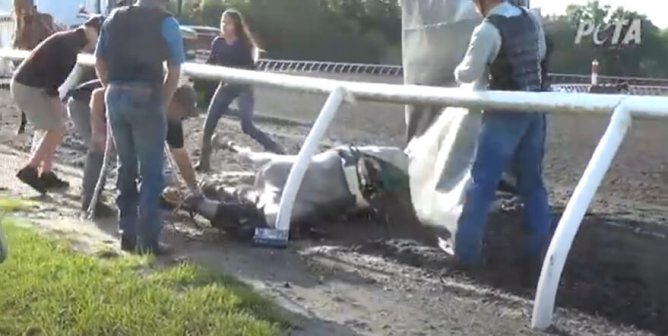
Both horses were "raced" twice in one day—something even fit thoroughbreds would never be subjected to. Healthy racehorses need at least a week to recover from the stress of competition. Indeed, they aren't even exercised twice in one day. Both horses on the set of Luck broke down after the second run. Their leg fractures were so violent that their bones shattered under the pressure. We think—and we hope law enforcement agrees—that the way in which the horses were treated by the production company, the trainer, and the veterinarian warrants a swift and thorough investigation before yet another horse dies.
Human affection for horses unfortunately makes them popular subjects for the film industry. Horses may grab our attention, but these animals are not willing participants in the entertainment industry.
Written by Jennifer OConnor
At PETA's urging, a major thoroughbred auction company has made a crucial change at this month's sales event that could reduce the risk of injury to horses forced to participate in "under tack shows"—dangerous sprints that thoroughbreds are forced to run just to impress potential buyers.
A PETA undercover investigation documented that 2-year-old horses—whose bones and muscles are still not fully developed—suffered catastrophic injuries and fatal breakdowns during these one-eighth or quarter-mile sprints.
Now, Ocala Breeders' Sales Company (OBS) has implemented PETA's most significant recommendation for its January under tack show: eliminating deadly timed sprints for juvenile horses, some of whom are just yearlings.
PETA has asked all four major thoroughbred auction companies—Ocala Breeders' Sales Company, Fasig-Tipton Company, Keeneland Association, and Barretts Equine Limited—to adopt a series of reforms to make these races safer for horses.
PETA will continue to push all the auction companies to protect horses by implementing all our crucial reforms. You can help by urging the auction companies to act now.
Update: PETA investigators have released the following undercover video, showing horses as they were forced to run so fast that they suffered broken bones, burst aortas, and other potentially fatal injuries. This video footage will be used to push thoroughbred auction companies to institute PETA's proposed reforms.
PETA has documented yet another example of how merciless and mercenary the thoroughbred racing industry is. Two-year-old horses are forced to perform in reckless speed trials known as "under tack shows" to impress prospective buyers at auctions. These young horses, whose fragile bones, tendons, and muscles are not yet fully developed, are pushed to sprint one-eighth of a mile at breakneck—or, rather, breakleg—speeds.
PETA investigators have documented that forcing these baby horses to run at extreme speeds at auctions and during training for these events can result in dangerous accidents, broken bones, and death. Equine veterinarian Dr. Sheila Lyons, who has been featured on the cover of The Blood-Horse magazine, writes: "Pushing these immature 2-year-old horses for speed before they have reached physical and mental maturity is recklessly dangerous and systematically damaging for the animal while also proving to be unreliable for the prospective buyers as a predictor of future racing ability."
PETA is urging the four major thoroughbred auction companies, Fasig-Tipton Company, Ocala Breeders' Sales Company, Keeneland Association, and Barretts Equine Limited, to adopt a series of reforms, including the following:
Help us put an end to this unnecessary suffering. Please take a moment to politely urge the four major auction companies to implement PETA's proposed reforms.
Written by Jennifer O'Connor
If you have a general question for PETA and would like a response, please e-mail Info@peta.org. If you need to report cruelty to an animal, please click here. If you are reporting an animal in imminent danger and know where to find the animal and if the abuse is taking place right now, please call your local police department. If the police are unresponsive, please call PETA immediately at 757-622-7382 and press 2.
Follow PETA on Twitter!