Written by PETA
Remember those stomach-churning scenes from PETA's undercover investigation at a horse slaughterhouse? Horses, discarded by the racing industry, were slaughtered and hacked into pieces. On the heels of that horrific case, we went to the one organization that deals with every thoroughbred breeder in this country—The Jockey Club, which handles all foal registrations—and asked why the run for the roses had turned into a race for horses' lives. We gave Jockey Club officials a detailed proposal for implementing and funding a real thoroughbred retirement program, the Thoroughbred 360 Lifecycle Fund. More than 32,000 PETA members and supporters wrote in support of it.
The Jockey Club paid attention. Today, less than a year after receiving our recommendations, The Jockey Club, the Keeneland Association, and the Breeders' Cup, Ltd., have announced the launch of an organization—the Thoroughbred Aftercare Alliance (TAA)—composed of owners, trainers, breeders, racetracks, jockeys, horse-rescue experts, and others in the racing industry. The TAA will begin by laying the groundwork for the program. As we suggested, it will inspect every stable and sanctuary that wants to provide a home for a thoroughbred. The facilities that make the grade will be accredited. And then the TAA will raise funds to get the horses into those homes.
There's much more work to be done, and it won't end all the cruelty in racing, but making a lifetime commitment to the horses these groups depend on for their income is a good start.
Written by Kathy Guillermo
Television news pieces airing today are advertised in such a way as to again misrepresent our stance on horse slaughter—just as some legislators also seem to have been misusing and misstating our position. Let's set the record straight once more, shall we? Please cut and paste this to your computer so you can forward it to anyone who gets it wrong. Thank you.
To be crystal clear: While PETA is appalled at the transport of horses to foreign destinations, which increases their stress and susceptibility to sickness and injury, and believes that the previous congressional action that ended the slaughter of horses in the U.S. was inadequate to address the problem of unwanted and abandoned horses, PETA does not support a reopening of horse-slaughtering operations. Because of the lack of sufficient good homes for unwanted horses, PETA does support euthanasia by injection or gunshot carried out locally. PETA also strongly supports the American Horse Slaughter Prevention Act of 2011 (S. 1176/H.R. 2966), a vital bill that would ban horse slaughter in the U.S. and, crucially, prevent the export of horses from the U.S. for the purpose of slaughter, and we urge everyone who cares to reduce the suffering of horses to contact their congressional representatives to support it too.
Written by Lindsay Pollard-Post
Sparks flew recently after Congress restored funding for U.S. inspectors to oversee horse slaughter, opening the door for horses to be killed and butchered in the United States for the first time since 2006. But there is hope for a better bill: The American Horse Slaughter Prevention Act of 2011 (S. 1176/H.R. 2966), which would outlaw horse slaughter in the U.S. as well as close the loophole that previously allowed horses to be sent on grueling journeys to slaughterhouses in Mexico and Canada, something that added approximately 230 extra miserable miles to their already miserable lot. Horses urgently need anyone and everyone you can enlist—your neighbors, friends, coworkers, and family—to actively support this act. Please click here to register your support now.
Each year, more than 130,000 frightened horses are trucked from the U.S. and killed in slaughterhouses in Canada and Mexico. After enduring hundreds of miles jostled about in cramped trucks—often in extreme temperatures without food or water, on slippery floors, their heads bent over from the low ceilings, being kicked and bitten by other horses—they are shot in the head, are strung up by one leg, and have their throats cut.
The American Horse Slaughter Prevention Act of 2011 would prohibit shipping, transporting, moving, delivering, receiving, possessing, purchasing, selling, or donating horses and other equines for human consumption. In other words, it would effectively end the use of U.S. horses for food—both here and abroad!
This lifeline for horses is currently sitting in Congress and requires that we act fast. Please click here now to urge your members of Congress to vote in favor of the American Horse Slaughter Prevention Act of 2011. Ask everyone you know, and set up tables to enlist those you don't, to do the same.
Written by Jennifer OConnor
After a 5-year hiatus, Congress has restored funding for U.S. inspectors to oversee horse slaughter, opening the door for horses to be killed and butchered in the United States for the first time since 2006.
No one wants to see any horse killed for meat or to turn a fast buck, and PETA has always had concerns about the suspension of US slaughter, since it meant more suffering for these sensitive animals, not less. What we feared would happen did: Rather than have a change of heart and stop killing horses, greedy ranchers who deal in horse flesh simply jammed their “commodities” into tractor trailers and hauled the frightened animals hundreds of miles to Canada and Mexico – a journey most did not have to face before - to terrifying deaths in slaughterhouses there.
As PETA documented years ago, that ride means horses crammed together with strangers who bite and kick, slippery floors that mean foals and pregnant mares fall and are trampled, and horses who, being taller than cows but often shipped in cattle trucks, must ride the whole way with their heads bent to their chests. That export loophole still needs to be slammed shut.
To reduce horses’ suffering, there must be a ban on exports of live horses together with a ban on slaughter in the U.S., or it doesn’t work, never did, never will.
Remember, industries that breed horses for profit—horseracing, rodeo and the carriage trade—are largely to blame for this crisis since they have created the tragic overpopulation of horses.
Help force breeders to take some responsibility for the horses they use up and then discard by signing PETA's petition to the Jockey Club calling for the club to establish a retirement fund for registered thoroughbreds.
PETA Files readers already know that few "retired" racehorses live out the remainder of their days frolicking in rolling green pastures. Now, Washington Post readers know it, too, thanks to a great article that was published over Memorial Day weekend.
The article describes one of the many ugly sides of the horse-racing industry—the fact that with approximately 35,000 thoroughbreds born in the U.S. every year, there are thousands of horses who don't have quite enough speed and stamina to be champions. What becomes of these also-rans? Most are eventually sold at auction, where many are bought by "killer buyers."
While no horse slaughterhouses are currently operating in the U.S., horses are still being shipped to slaughterhouses in Canada and Mexico. Some retired racehorses—even Derby champs like Ferdinand and Charismatic—also wind up in Japan, where they may initially be used for breeding. But when they stop being moneymakers, they, too, may be slaughtered, as a PETA investigation at a Japanese slaughterhouse last year revealed.
You can help by contacting your U.S. representatives and asking them to sponsor the Prevention of Equine Cruelty Act, which would make it illegal to slaughter horses for consumption in the U.S. or to export them for slaughter.
Written by Alisa Mullins
Sure, some men joke about how to score with women, but the horse-racing industry's use of stallions to impregnate tens of thousands of mares—in the quest for one big winner—is no laughing matter.
The good news is that thoroughbred breeding stats for 2009 show a decline in the number of horses who were bred. The number of stallions bred dropped almost 9 percent, and the number of mares bred fell 13.5 percent, according to The Jockey Club. Don't misunderstand—there's still a whole lotta suffering in the making. This year alone, more than 45,000 mares were "covered" (bred), which means that tens of thousands of foals will be born into the racing industry and face the risk of suffering broken bones, being drugged, and being abandoned, neglected, or shipped overseas for slaughter when they are no longer considered "useful." Most of the slaughtering of U.S. horses takes place in Mexico and Canada: More than 100,000 U.S. horses per year are trucked to Mexico and Canada to be slaughtered (and more than 10,000 of those horses are thoroughbreds formerly used for racing).
The Kentucky Derby and other high-stakes races represent the suffering of thousands of horses—day in and day out, year in and year out. While the drop in breeding means that fewer horses will be born to suffer a lifetime of abuse, there's still much more work to be done. Take a minute to check out our investigation into a Japanese horse slaughterhouse and write to the National Thoroughbred Racing Association and demand breeding limits.
Written by Karin Bennett
Horses who pull heavy loads of tourists through noisy, polluted city streets are not retired to pastures where they graze their final days away. This anonymous contribution to PostSecret.com assures us of that.
To the anonymous poster, if your conscience bothers you, our investigators eagerly await more details.
I'm sure that once her career was over, Shawn would have been sent off to Japan and ground up into dog food anyway.
Written by Shawna Flavell
In 2002, the 1986 Kentucky Derby champ, Ferdinand, was slaughtered after his breeding days in Japan were done.
Fast-forward to 2009: Two more horses, Charismatic and War Emblem—Kentucky Derby champs from 1999 and 2002 respectively—may also face slaughter as their usefulness to breeders comes to an end.
After breaking his leg in the 1999 Belmont, Charismatic was sold to breeders in Japan. His value as a breeding stallion has dropped dramatically (to approximately US$5,000), and he has been moved to the lowest-ranking of breeding farms.
Just a few years ago, horse-racing fans cheered as Charismatic and War Emblem ran away with top prizes at the Kentucky Derby and Preakness Stakes. Now, PETA's most recent undercover investigation shows what could be in store for these once-celebrated stallions and thousands of other horses sold into the Japanese thoroughbred industry.
Each year in Japan, more than 20,000 horses, including many horses once used for racing, are slaughtered for dog and human food. This video shows the slaughter of a young thoroughbred. As stated in the New York Times, "The video is disturbing. It shows in graphic terms what happens to the unfortunate thoroughbreds who become spare parts in a contracting industry."
You can blame the U.S. horse-racing industry for the carnage. It routinely breeds tens of thousands of "surplus" thoroughbreds every year, then sells thousands of them to breeding facilities in Japan. More than 2,000 U.S. thoroughbred horses and breeding mares have been shipped to Japan since Ferdinand was slaughtered in 2002.
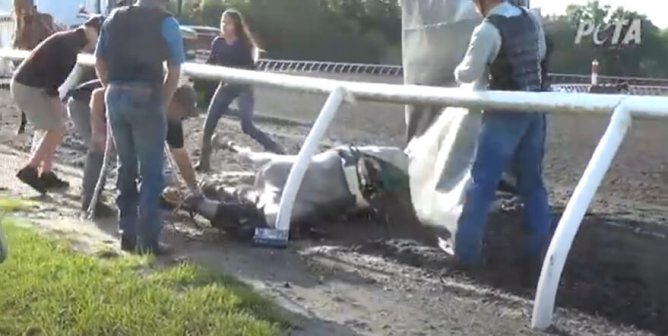
Just last year, Americans watched in horror as racing filly Eight Belles suffered fractures to both her front ankles and was euthanized just moments after running the Kentucky Derby. How can anyone not be disgusted by the shuffling of thousands of horses off to Japan and into slaughterhouses?
Join us in defending former Derby and Preakness champs Charismatic and War Emblem—and thousands of other thoroughbreds. Demand limits on breeding and a ban on the export of horses to Japan.
Full disclosure: I am a sucker for horses. Just watching them run makes me cry. Seriously, it does. That video clip that was shown in Amélie, in which an excited horse leaps over a pasture fence and joins passing Tour de France cyclists? I cry just thinking about it—shoot, I'm crying right now!
So you can imagine my reaction to the news that Thoroughbred breeder and owner Ernie Paragallo has been charged with cruelty to animals after 177 horses were allegedly found starving, suffering from skin infections and untreated injuries, and crawling with lice and worms on his New York state farm. The raid on the farm came shortly after news leaked out that four mares who formerly belonged to Paragallo had been rescued from a "kill pen," bound for the slaughterhouse. PETA called for his prosecution soon after this hit the news.
This isn't the first time that Paragallo has run into trouble. In 2007, three starving horses were rescued from his farm and spent a month recovering at an equine hospital. In 2005, his owner's license was revoked over his failure to pay a vet bill.
In my opinion, hangin's too good for Paragallo. This man has raked in more than $20 million in winnings over the years—and he can't spend even a fraction of that wealth on care for the horses who earned it for him?
Fortunately, the cruelty charges, coupled with the slaughterhouse boondoggle, seem to have been enough to convince the New York State Racing Commission to bar Paragallo from the state's tracks. This means that Paragallo will almost certainly be unable to enter a horse in the state's "big show"—the Belmont Stakes—in June.
Boo-hoo. (That's sarcasm—I'm not really crying this time.)
Follow PETA on Twitter!
If you have a general question for PETA and would like a response, please e-mail Info@peta.org. If you need to report cruelty to an animal, please click here. If you are reporting an animal in imminent danger and know where to find the animal and if the abuse is taking place right now, please call your local police department. If the police are unresponsive, please call PETA immediately at 757-622-7382 and press 2.