Written by Jeff Mackey
Karl Mitchell's days of terrorizing big cats in Nevada's Nye County are numbered now that the notorious animal abuser and unrepentant lawbreaker has had his permit to keep exotic animals revoked by the county's board of commissioners based on information that it received from PETA and the U.S. Department of Agriculture (USDA).
Like Abu Ghraib for Tigers
Mitchell, who owns an appalling tiger menagerie called Big Cat Encounters, has been exhibiting animals even though his exhibitor's license was permanently yanked by the USDA in 2001, meaning that the county shouldn't have issued him a permit in the first place.
In February 2012, PETA called on the USDA and the U.S. Fish and Wildlife Service to seek criminal charges against Mitchell for exhibiting tigers and transporting them across state lines without a license. The federal investigations are still pending.
Over the years, the USDA has cited Mitchell repeatedly for a wide range of atrocious Animal Welfare Act violations, which include cruelly withholding water as a training technique, continuing to exhibit big cats illegally, and failing to provide animals with adequate veterinary care and living conditions and palatable food and water—just to name a few. Mitchell has also been slapped with three cease-and-desist orders (which he, of course, defied) and more than $100,000 in fines.
What You Can Do
Although Mitchell is a particularly flagrant and disgraceful example of the low ethical standards of his industry, misery is inescapable for all animals who are imprisoned so that they can furnish a momentary diversion instead of living their natural lives in freedom. Please never patronize any captive-animal attraction.
Written by PETA
The following was written by Joel Bartlett.
StarCraft players gearing up for the launch of StarCraft II: Heart of the Swarm will be getting a new perspective on the game's arthropodal extraterrestrials, the Zerg.
PETA—or, as we are renaming ourselves in honor of the expansion pack's launch, "Terrans for the Ethical Treatment of Zerglings"—will attend tonight's launch event in Irvine, California, and distribute copies of our new "Zerglings Have Feelings, Too" leaflets as a reminder that gamers and nongamers alike should have compassion for all beings—even those who are very different from us.
Heart for the Swarm
We always root for the underdogs (and undermice and underpigeons, etc.) at PETA. And when playing StarCraft, I had noticed how the Zerg were treated more like animals than like other people. I couldn't help but wonder if there would be an analog to PETA in the world of StarCraft. Tonight, my dream will come true.
People often wonder what PETA has against video games, especially after playing our Pokémon: Black and Blue or Super Tanooki Skin 2D parody games, which have each gotten millions of people to think about PETA's issues and, together, have led to more than 750,000 people watching PETA's hard-hitting videos. The truth is that as a gamer and a PETA staffer, I get excited about combining my passions.
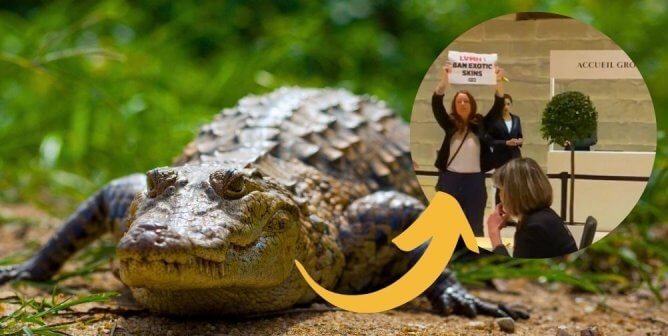
So remember, while Zerglings are not real, there are many equally "strange" and exotic animals we share this planet with who deserve our empathy. Just because crocodiles and snakes look alien to us, that doesn't make it OK to skin them alive for a handbag, shoes, or a belt.
And if we had to share our world with the Zerg in reality, I'd like to think that we'd make an effort to understand and respect them rather than sending out the battlecruisers—because the alternative to having empathy for other beings is about as grim as it gets, whether you're a Terran, a Zerg, or a Protoss. OK, whoa, that got kind of serious there. What I am saying is look at the cute Zergling! How could anyone ever want to hurt a Zergling?
If all this talk of "Zerg rights" has you thinking, I recommend that you check out Animal Liberation, the groundbreaking book by Peter Singer, which is credited with kick-starting the modern animal rights movement. What does "animal liberation" even mean? See PETA's summary of the book here to find out.
Written by Michelle Kretzer
Presidential debate moderator Candy Crowley likes getting into meaty issues—but not into meat. Maybe it was her vegetarian diet that gave her enough energy to keep the candidates in line?
Newly vegan Kristen Bell doesn't miss an opportunity to advocate for animals—and she doesn't miss dairy products, either. "[H]onestly, there are so many good substitutes available now that I really don't miss anything," she told Shape magazine. Kristen also mentioned that as much as she loves sloths, she would never keep one because, she says, "I don't support the exotic animal trade."
Salma Hayek agrees. She told Jimmy Fallon, "I am completely against people having exotic animals as pets. This is completely, completely wrong." Gushing about her passion for rescue, she rattled off all the animals who inhabit her estate, adding, "See, I had no husband, no children. I only had my animals, and I'm not going to get rid of them just because I fell in love, and, you know, motherhood. "
Ben Stiller realizes that exotic animals don't belong behind bars, either. The funnyman got serious when asked how he feels about zoos, saying, "I used to be for it. Now I'm against it. I don't love zoos; I've taken my kids to them but I saw that documentary a couple of years ago, The Cove, and that affected me in terms of knowing how these dolphins get into these dolphin parks. So I stopped supporting them." What else have Stiller and his family stopped supporting? The meat and dairy industries—Stiller and his wife, Christine Taylor, are vegan and are helping their kids embrace veganism, too.
The winner of RuPaul's Drag Race, Sharon Needles, embraced flesh of the human variety for her Halloween-themed pro-vegetarian ad for PETA. Drag royalty Lady Bunny was one of the multitude of folks speaking up for animals on Twitter this week, posting her excitement about the new ad:
Leonardo DiCaprio knows that sometimes you need a little more than 140 characters, so he is devoting his Facebook page to the protection of whales, orcas, seals, and penguins. The actor asked for support for the Antarctic Ocean Alliance, which aims to create "the world's largest network of marine protected areas."
Pamela Anderson is ready to take her advocacy for horses face to face: She invited New York City Council Speaker Christine Quinn on a date! Pam is set to host a gala that will benefit the campaign to replace horse-drawn carriages with eco-friendly replicas of classic cars, and she thinks that if Quinn attends, the speaker will reconsider her support of the horse-drawn carriage industry.
To keep up with what your favorite stars are doing for animals, follow @PETA on Twitter.
After hearing from PETA, the city of Corona, California, ordered the Ramos Bros. Circus to halt its illegal display of exotic animals immediately.
Apex Feline|cc by 2.0
PETA received several calls from members telling us that Ramos Bros. was displaying exotic animals, including zebras and camels, which is illegal in Corona. We promptly contacted the city, which sent an inspector to the circus. After the inspector confirmed that Ramos Bros. was illegally displaying exotic animals, the city ordered the circus to remove the animals or be shut down, noting that Ramos Bros. had previously been informed of the prohibition on displaying exotic animals.
The U.S. Department of Agriculture has repeatedly cited Ramos Bros. for violations of the Animal Welfare Act, and numerous citizens have called PETA to report disturbing abuse that they witnessed, including observing a large number of scars on animals' bodies and seeing animals confined to cramped, filthy enclosures with no access to water or shade.
This victory sends a strong message to cruel circuses that abuse won't be tolerated. Join PETA's Action Team today to help enact a similar ban and work to help animals in your community.
A temporary booth set up in Orlando by the Florida Fish and Wildlife Conservation Commission (FWC) started to look like a scene from The Jungle Book after the agency gave "amnesty" to people in possession of exotic animals banned under Florida law and agreed to take in the animals and place them in facilities equipped to care for them.
The point of the agency's first Exotic Pet Amnesty Day wasn't to cut illegal animal owners a break—it was to keep owners from simply turning reptiles, turtles, sugar gliders, and other exotic animals loose in the wild, where they would disrupt the local ecosystem and perish slowly and painfully.
Abandonment of exotic animals—who are usually purchased on impulse by unprepared and uninformed consumers—is just one of many serious problems associated with the exotic-pet industry. Many exotic animals are stolen out of their habitats in the wild, torn from their families, and shipped in cramped, filthy containers across the world before being warehoused in massive mills, awaiting their ultimate destination: pet stores, including pet-trade giants PETCO and PetSmart.
A PETA investigation into international animal dealer U.S. Global Exotics revealed that animals were crammed into pillowcases, shipping crates, troughs, and even plastic bottles, sometimes for weeks at a time. Many who were sick or dying were frozen to death in a freezer. Our investigation resulted in the largest animal seizure in history, the closure of the facility, and the issuing of an arrest warrant by the federal government for owner Jasen Shaw. But exotic animals are still suffering at the hands of other dealers like Rainbow World Exotics and Sun Pet Ltd., which supply PETCO and PetSmart stores across the country. Despite evidence of systemic cruelty and neglect at these small-animal factory farms, PETCO and PetSmart refused to sever ties with Rainbow and Sun Pet and continue to buy animals from them.
Good for the Florida Fish and Wildlife Conservation Commission for preventing animals acquired on a whim from suffering uncertain fates in a concrete jungle far from their natural homes. To help do the same, click here to e-mail PETCO and PetSmart and demand that they stop selling animals.
Written by Michelle Sherrow
Less than two weeks after four dozen wild and exotic animals were shot to death in Zanesville, Ohio, there's still somebody out there who didn't get the message that privately owning exotic animals is a recipe for disaster—and that somebody is Marian Thompson, the wife of the man who owned (and released) all the animals in the first place. Ms. Thompson is demanding that four of the six survivors—a grizzly bear and three leopards—in temporary quarantine at the Columbus Zoo, be returned to her immediately.
PETA has sent urgent letters to the U.S. Fish and Wildlife Service (FWS) and the Muskingum County prosecutor imploring them not to return the animals until investigations into whether the animals were harmed or harassed in violation of the Endangered Species Act and/or Ohio's anti-cruelty laws are conducted. It appears that the animals may have been obtained without proper permits in the first place and that they were kept in filthy conditions with insufficient food, water, and/or shade—all violations of the law. On top of it, public records indicate that there are nearly $70,000 in liens hanging over Ms. Thompson's head, leaving her ill-equipped to properly take care of the animals.
While we continue to fight to keep the survivors safe, you can help by e-mailing the Ohio Department of Natural Resources to politely urge the agency to exercise its authority to implement emergency regulations to prohibit the keeping of exotic and wild animals.
Written by Amanda Schinke
In response to the tragic bloodshed that occurred in Zanesville, Ohio, on Tuesday, the governor of Ohio has issued an executive order that directs state agencies to increase inspections of facilities that harbor exotic animals and sets up a hotline for the public to report unsafe exotic-animal situations. While PETA is glad that the governor is finally taking action on this issue, it is too little, too late, for the dozens of animals who were shot dead in Zanesville.
The executive order does nothing to address the fundamental problem—the fact that the state of Ohio allows private citizens to keep wild animals, which poses a danger to both animals and people. Just last year, a privately held bear mauled and killed a young man in Cleveland. That's why PETA is calling on the Ohio Department of Natural Resources to exercise its authority to implement emergency regulations to prohibit the keeping of exotic and wild animals immediately.
The governor's executive order indicates that a legal framework for regulating dangerous wild animals will be proposed by November 30, but there is no need for delay: A ban on the private ownership of wild animals should be put in place right away.
Exotic and wild animals kept as pets always pay the price, whether they are shot and killed, as happened in Zanesville, or confined to backyards, basements, or garages, forced to lead lonely, desolate lives that are devoid of anything that they would experience naturally in the wild.
PETA, along with other animal protection organizations, sanctuaries, zoological facilities, the Association of Zoos and Aquariums (AZA), the American Veterinary Medical Association (AVMA), and the Centers for Disease Control and Prevention (CDC), condemns the private ownership of exotic and wild animals as pets—both for the animals' protection and the public's safety.
Please click here to visit the Ohio Department of Natural Resources website and politely urge the agency to exercise its authority to implement emergency regulations to prohibit the keeping of exotic and wild animals. Let's help ensure that a tragedy like the one in Zanesville has little chance of happening again.
Zanesville, Ohio, sheriff's deputies armed with assault rifles opened fire on dozens of "mature, very big, aggressive" lions, tigers, cheetahs, wolves, and bears who had escaped from a private menagerie in Ohio after the farm's owner, Terry Thompson, was found dead and the animals' cage doors were left open and fences unsecured. Primates were found locked in cages inside the house. 48 animals were killed.
Thompson had a long history of brushes with the law and had just completed a one-year sentence on two federal counts of possessing illegal firearms. In November 2005, Thompson was convicted of, among other things, cruelty to animals and was subsequently sentenced to six months of house arrest and fined $2,870. PETA had filed complaints with the U.S. Department of Agriculture regarding Thompson's illegal activities, including exhibiting animals without a license and declawing tiger cubs in violation of the Animal Welfare Act. Ohio has no regulations governing the ownership of exotic and dangerous animals. Exotic animals all over the state languish without adequate food, water, and veterinary care. They eat rotten scraps, drink algae-laden water, and spend their days pacing on feces- and urine-encrusted dirt. Just last April, Ohio Gov. John Kasich refused to extend an emergency ban on exotic animals in the state, which was put in place by his predecessor. PETA has campaigned for an outright ban for many years.
Please join PETA in asking the Ohio Department of Natural Resources to exercise its authority to declare emergency regulations to prohibit the keeping of exotic animals and also seize the animals over whom the agency has jurisdiction and see that they are placed in reputable sanctuaries.
Written by Jennifer O'Connor
One zoo employee has been killed and another maimed in incidents at two separate zoos on the same day. At Riverside Discovery Center in Scottsbluff, Nebraska, a chimpanzee bit a worker on the hand, severing two of her fingers and injuring a third. At the Knoxville Zoo in Tennessee, elephant handler Stephanie James died from injuries she sustained when an elephant crushed her against a wall.
These incidents illustrate the very real dangers posed by captive exotic animals—and why laws like those recently passed in Ohio and Oregon that ban exotic “pets” are so desperately needed. Attacks like the one on Ms. James are part of the reason why we're encouraging all zoos to switch to a protected-contact system of handling—and we're even offering to cover part of the costs.
In protected contact, which is already being used by more than half the accredited zoos in the country, a safety barrier is kept between elephants and handlers at all times. This eliminates the "need" to establish dominance over elephants through beatings with bullhooks and other forceful control methods. The Knoxville Zoo has temporarily implemented protected contact since the trainer's death and is re-evaluating its elephant-handling program.
Way to go, Ohio! Gov. Ted Strickland issued an executive order today prohibiting Ohio residents from owning, breeding, selling, or trading wild exotic animals. People who already own exotic animals will not be allowed to breed, sell, or trade them and will have to register them with the state each year, making it easier for law enforcement to monitor the animals.
The ban comes none too soon. Ohio has had its share of captive animal attacks—the most recent being the fatal attack by a black bear on a handler last August. Wild animals who are kept in captivity are denied everything that is natural and important to them, and this causes many of them to lash out in frustration.
Barely a month ago, lawmakers in Oregon passed a similar ban designed to protect both animals and humans from the often dire consequences of keeping wild animals in captivity. Hopefully, more states will quickly follow suit. In the meantime, we'd like to remind you never to patronize roadside petting zoos, traveling shows, or "take-a-picture-with-a-tiger" exhibits. True wildlife sanctuaries aren't open to the public, don't take animals on the road, and never breed animals.
If you have a general question for PETA and would like a response, please e-mail Info@peta.org. If you need to report cruelty to an animal, please click here. If you are reporting an animal in imminent danger and know where to find the animal and if the abuse is taking place right now, please call your local police department. If the police are unresponsive, please call PETA immediately at 757-622-7382 and press 2.
Follow PETA on Twitter!