Written by Michelle Kretzer
Bollywood beauty Dia Mirza put herself in a skinned snake's shoes to ask her fans to walk away from exotic-animal skins.
Photo: Jatin Kampani | Stylist: Theia Tekchananey | Make-up: Nahush Pise | Hair: Shobha Kewal
"[J]ust putting myself in the place of that snake or that crocodile made me feel sick," she said. "How can you wear anything that kills an animal so cruelly to make yourself look good?"
The style that looks good from Bollywood to Boston is kindness. Check out PETA's Polyvore page for oodles of hip, cruelty-free fashions.
Written by PETA
Toronto Fashion Week is all about the clothes, but one star was there in the flesh—hers. With her naked body painted to resemble a lizard's skin, Laura Vandervoort, of Smallville and V fame, stars in a new ad for PETA (shot by photographer Nick Saglimbeni) that she unveiled at Toronto Fashion Week while asking her fellow Canadians to shed exotic skins from their wardrobes.
Laura first appeared as a reptile in V, but this time around, she reprised her role as a lithe lizard to help protect the animals from being killed for their skins. "Three or four alligators have to die for one purse," she said in an exclusive interview from the photo shoot. "They nail the snake's head to a tree while it is still alive and peel its skin off. Because they are cold-blooded creatures, they take that much longer to die, so they suffer that much longer. … [Y]ou wouldn't skin your dog to wear to an event, to go out on a date, just for a status symbol. So please, have some compassion for animals."
To see behind-the-scenes video footage from Laura's photo shoot and enter to win a faux-snakeskin bag, check out her full PETA feature.
Written by Michelle Sherrow
In the wake of news reports that Arizona Cardinals defensive lineman Darnell Dockett recently acquired a "pet" alligator, whom he named Nino, PETA sent the defensive back a letter giving him a heads up that owning an alligator is unlawful in Arizona without a special permit and is heavily regulated in Florida (where Dockett acquired Nino). We've offered to help Dockett find a suitable permanent habitat for Nino.
Alligators in the wild roam freely and protect their territories, travel long distances, and thrive in the rivers and lakes that they call home. They never become "tame," and forcing one to live in confinement only makes for a frustrated and unhappy animal. Not only is this unfair to this gator, it is also dangerous for everyone.
We hope Dockett will take us up on our offer, and in the meantime, you can help by spreading the word about the miserable lives led by exotic animals kept as "pets."
Written by Jennifer O'Connor
At the rate victories are rolling in, 2010 is set to be a great year for animals! In addition to a victory for greyhounds, yesterday, online mega-retailer Overstock.com announced that it will no longer sell products made from exotic skins.
Overstock.com Chair and CEO Patrick Byrne made the announcement that his company would remove all listings of items with alligator, lizard, ostrich, stingray, eel, shark, and kangaroo skin from Overstock after he viewed our newest exotic-skins footage and was prompted to make a change for his company, his customers, and animals. "I do not believe that animal skins should be treated as decorative objects," he said.
From decapitated lizards to clubbed alligators, millions of animals suffer each year in the global leather industry, even though there are tons of cruelty-free, chic alternatives to animal skins. You can send a powerful message to those who profit from this cruel industry—and convince other companies to follow in the footsteps of Overstock and H&M—by pledging to shed exotic skins from your wardrobe and by sharing our exposé on Facebook.
Written by Logan Scherer
After reading an article in the Duluth News Tribune about the goings-on at the University of Wisconsin-Madison, I took my dogs, Charlie and Lucy, for a long walk. My brain needed to mull over the angle I'd take in writing this blog—my soul needed to witness happy dogs doing dog things like sniffing tree trunks and greeting strangers, canine and human alike.
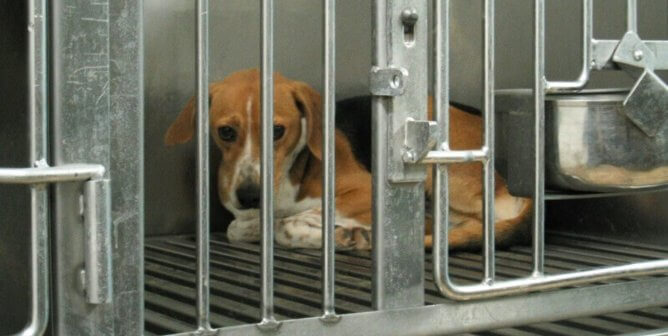
The article discussed a lengthy report compiled by government inspectors after a surprise visit last month revealed a filthy facility in which depressed dogs who underwent major invasive surgical procedures were vomiting in their cages and did not receive any veterinary treatment, university personnel did not notice or treat a gerbil who was severely emaciated and struggling to breathe, and staff were inadequately trained to handle primates. The Duluth News Tribune notes, "One major finding is that in five studies, UW-Madison researchers did not show that they tried to find an alternative to painful experiments on animals."
Unfortunately, this kind of treatment happens so frequently in university labs that it is almost routine—as awful as it is to call such horrors "routine." A recent PETA undercover investigation exposed similar cruelty suffered by cats, kittens, and dogs (purchased from local animal shelters), along with monkeys, mice, rats, and other victims of experiments at the University of Utah. At the U, what appears to be incompetence, indifference, and neglect forced many of the animals to endure severe trauma, prolonged suffering, and grisly deaths. Apparently, vivisectors at UW-Madison follow a similar modus operandi in the treatment of the victims of their experiments.
Our fingers are crossed that UW-Madison receives more than a slap on the wrist for these violations. While we keep an eye on the story, take the time to give our fight against laboratory atrocities some muscle by taking action today. Then go hug your own dog and give him or her an extra treat.
Written by Karin Bennett
H&M is an industry leader in all things stylish and cruelty-free—which is why we were thrilled to announce that, because of its recent decision to implement a permanent policy against selling any exotic skins, including those of snakes, alligators, crocodiles, lizards, ostriches, and other animals, H&M is the recipient of our Company of the Year Proggy Award. H&M's announcement to no longer sell exotic skins came after we sent a copy of our new exposé to the universally loved retailer. (Seriously, H&M is like apparel candy: affordable and deliciously fashionable, and I don't know anyone who doesn't love them.)
Many animals who are stripped of their skin for fashion are skinned alive and then tossed onto a pile where they writhe in pain until they succumb to shock or dehydration. Some animals live in agony for up to four days after they lose their flesh. H&M's new policy sends the message that kindness is always chic. Follow this company's lead: Take our pledge and declare that the only skin you'll ever wear is your own.
PETA's naked "snakes" have been spotted recently on both coasts, drawing attention to the cruelty inflicted on scaly species who are killed for their skins. Not since Rebecca Romijn slinked around in painted-on scales as Mystique for the X-Men trilogy have people found reptiles so alluring.
If you have a general question for PETA and would like a response, please e-mail Info@peta.org. If you need to report cruelty to an animal, please click here. If you are reporting an animal in imminent danger and know where to find the animal and if the abuse is taking place right now, please call your local police department. If the police are unresponsive, please call PETA immediately at 757-622-7382 and press 2.
Follow PETA on Twitter!