Written by PETA
The latest issue of PETA's Animal Times magazine just rolled off the presses, and the PETA Files is offering you a sneak peak inside. In addition to campaign news and updates, investigative reports, and tasty recipes, this issue includes an exclusive excerpt from PETA President Ingrid E. Newkirk's latest book, The PETA Practical Guide to Animal Rights. In this excerpt, Ingrid talks about a personable rooster named Lucie, who changed the lives of the family that had the good fortune to adopt him:
A man selling chicks under a bridge sold Lucie for a dollar to a little girl. … She put him … in the basement in a shoe box with air holes and a tissue for a blanket …. The next day, the girl's mother Barbara Munroe, realized that the chick was freezing. She made a bed in her night table drawer .... Finally, Lucie went to sleep.
Barbara took to carrying Lucie around in her hand. He always wanted to be with people. "The most amazing thing to me," says Barbara, "was the way Lucie adapted to suburban life, sitting in a car like a perfect gentleman or on the sofa while the family read or watched television."
. . .
When Barbara would come home from work, she often saw Lucie sitting on the back of a chair in an upstairs window, watching for her. By the time that she got in, he was down in the kitchen, jumping up and down, greeting her.
If people in the house raised their voices, Lucie chimed in loudly. It was almost impossible to shout over him, and usually everyone ended up laughing.
Barbara's daughter kept her bedroom door closed. Lucie hated that …. Every once in awhile, the girl forgot to close the door. Lucie would run in and jump on her bed but remain very quiet, so as not to alert her.
All chickens have the potential of Lucie or more, if allowed to live a natural life—by which I mean, not confined to a tiny wire cage or to a filthy, ammonia-filled shed crammed in with thousands of other birds. The same is true of all animals we think of as "food." It is just that we never get to know them.
Want more? An annual subscription to Animal Times can be yours for just $16. What a bargain! Written by Alisa Mullins
If you make a donation of more than $100 before July 31, not only will your generous gift be matched, you will also receive a signed copy of Ingrid E. Newkirk's book One Can Make a Difference: How Simple Actions Can Change the World. Here are the rules: You must send us a copy of the donation receipt you received in return for your gift. Receipts must be dated between June 11, 2010, and July 31, 2010, and must be received by PETA by August 15, 2010. E-mail us your donation receipts or mail them to the following address: Kim Venetzc/o PETA "Bob Barker Book Offer" 501 Front St.Norfolk, VA 23510 Requesters must be U.S. residents. Limit one book per household.
If you make a donation of more than $100 before July 31, not only will your generous gift be matched, you will also receive a signed copy of Ingrid E. Newkirk's book One Can Make a Difference: How Simple Actions Can Change the World. Here are the rules:
Kim Venetzc/o PETA "Bob Barker Book Offer" 501 Front St.Norfolk, VA 23510
The following blog originally appeared on PETA Prime:
There are moments in history when individuals make a choice in concert with others, and that choice reverberates for decades. Groups often form in response to a challenge from one individual. Take Henry Bergh, for example, a man of the early 19th century who led people to band together to bring about anti-cruelty legislation. Or Ingrid E. Newkirk and her decision 30 years ago to found PETA, which has resulted in monumental progress for animals. And now, with the generous help of Bob Barker, PETA is looking for 1,000 people who will step forward for animals by July 31. Will you be among the ranks or otherwise help us meet his challenge?
As you may know, Bob Barker recently gave PETA $2.5 million to create a new nerve center for animal rights in Los Angeles. At the time that the Bob Barker Building was dedicated, Barker issued a challenge: He offered to donate an additional $2 million to match certain gifts to PETA—one of those gifts being new memberships. And that's where you come in, even if you already are a member.
PETA always has more opportunities to help animals than financial resources to carry out the work. The new Bob Barker Building isn't just about bricks and mortar. Just as PETA investigators go wherever change for animals is needed, PETA wants its staff members to be based wherever they can benefit animals the most. By relocating our International Grassroots Campaigns, Youth Outreach Campaigns, and Marketing departments to our new Los Angeles headquarters, PETA will have more space to grow and more power to carry out our mission. You can help us change the world for animals by supporting Bob Barker's challenge.
If you are not yet a member, please step forward now with a contribution of $16 or more and support PETA’s work to end cruelty and promote respect for all animals and Bob Barker will match your gift. We are trying to recruit 1,000 new members by July 31 to kickstart our fundraising goals. You can become a PETA member by clicking here. Your donation will make a great difference because PETA is efficient as well as effective, with almost 81 cents of every dollar going directly to programs that help animals—and in this case, Bob Barker will double your dollar!
If you are already a member, please help us by finding one friend or family member who will step forward now for animals and have their gift matched by Bob Barker. You can help by sharing this blog post via Facebook, Twitter, or e-mail or in any other way that you can think of to help spread the word.
All current members receive a one-year subscription to PETA's colorful and informative magazine Animal Times, which features great new vegan recipes, heart-warming stories about animals, and information on how you can help protect animals.
In the first three decades of PETA's existence, we've seen great progress, but there is still so far to go. Won't you seize this historic opportunity to build PETA's membership so that we can continue to expose cruelty and act to end it? Please help PETA meet Bob Barker's challenge and change the world for animals!
Written by Scott VanValkenburg
For those of you who receive PETA's quarterly magazine, Animal Times, you're in for a treat (as always) when the latest issue hits mailboxes this month. If you haven't gotten around to subscribing (it's free with your PETA membership), here's one of the many great articles you'd find—an exclusive sneak peek at PETA President Ingrid E. Newkirk's newest book, The PETA Practical Guide to Animal Rights. Don't say we never gave you anything:
Man's best friend isn't, in many parts of the world. In Korea, the Philippines, Vietnam, and China, among other places, dogs are kept in the burning sun in small cages behind restaurants, often with tin cans shoved over their muzzles and their broken forelegs tied behind their backs. They are "tenderized" by being beaten while alive and then strangled to death and skinned for their flesh. In Thailand, dog-hide factory trucks prowl the streets, offering to trade plastic buckets for live dogs, who will be slaughtered and made into bags, drum skins, and golf-club covers. I grew up in India, where—although dogs are not eaten—mange-covered and starving stray animals are so common and so pathetic that they can't help but capture your attention. In the pounds, death was courtesy of a crude electrocution machine that seared the animals' skin and often set their fur on fire or via blows from men wielding billy clubs. In Taiwan—which has a robust economy as well as a large Buddhist population—one would think that animals would fare much better. The reality is quite the opposite. In Taiwan's pounds, death for dogs can come from live burial (digging a pit and throwing the dogs into it), electrocution, poison-laced food, starvation, or drowning. In April 1998, I rescued 11 dogs from the Keelung city pound's drowning tank and extracted a promise from the minister of the environment to immediately stop drowning animals. The city administrators have been good to their word, but all these years later, animals in Sanchung, Tu Chung, and other cities continue to suffer, confined to cramped, filthy cages at severely crowded pounds. Pressure is still desperately needed to bring about reforms. I used to harbor the illusion that all animals in Europe and North America were well-treated. But we have plenty of room for improvement too—to say the least. A Baltimore, Maryland, rescue group called Alley Animals has seen it all, right here in America: animals with festering wounds from slingshots and bottles, cats with elastic bands embedded in their necks, kittens blinded and used as bait in pitbull fights, abandoned Easter rabbits, a rooster wearing a broken ankle leash, and even a green iguana—now the most common exotic throwaway pet, according to news reports. Alley Animals operates simply and on a shoestring. When dusk falls on Baltimore, the group's volunteers drive into the sprawling old city's most rundown areas. Their job is to find the animal waifs and strays who creep out from their hiding places when the city grows quiet, knowing that they are less visible to juveniles armed with free time and a rock or a firecracker. One evening, volunteer Alice Arnold and her partner for that night's trip, Eric, were just leaving an alley after putting out food when Eric said, "Did you see that puppy?" He pointed to an overturned reclining chair amid the trash, where a tiny head was sticking out ever so slightly, the puppy's reddish-brown fur almost blending in with the color of the old chair in the alley's black shadows. The stuffing had come out of the chair, allowing the dog to claim its interior as her shelter from a world that had rejected her. Within a week of her rescue, it was obvious that the puppy—now known as "Stuffing"— was very intelligent and lovable. After a few weeks, Stuffing had gained weight, was paper-trained, and spent every night snuggled up in bed with her new human friend. Alice says that to look at her now, no one would ever guess that this happy little girl spent the first months of her life eating from trash cans and sleeping inside an overturned chair in a dark alley. Most people don't think that the problems of strays and chained "backyard" dogs have anything to do with them. But they do. The biggest nightmare plaguing domesticated animals in our society does not involve the wanton acts of violence directed toward them by cruel humans. Rather, it involves thoughtlessness by otherwise intelligent and caring people who simply do not understand what or who dogs and cats really are, and what they need to thrive.
Man's best friend isn't, in many parts of the world. In Korea, the Philippines, Vietnam, and China, among other places, dogs are kept in the burning sun in small cages behind restaurants, often with tin cans shoved over their muzzles and their broken forelegs tied behind their backs. They are "tenderized" by being beaten while alive and then strangled to death and skinned for their flesh. In Thailand, dog-hide factory trucks prowl the streets, offering to trade plastic buckets for live dogs, who will be slaughtered and made into bags, drum skins, and golf-club covers.
I grew up in India, where—although dogs are not eaten—mange-covered and starving stray animals are so common and so pathetic that they can't help but capture your attention. In the pounds, death was courtesy of a crude electrocution machine that seared the animals' skin and often set their fur on fire or via blows from men wielding billy clubs.
In Taiwan—which has a robust economy as well as a large Buddhist population—one would think that animals would fare much better. The reality is quite the opposite. In Taiwan's pounds, death for dogs can come from live burial (digging a pit and throwing the dogs into it), electrocution, poison-laced food, starvation, or drowning. In April 1998, I rescued 11 dogs from the Keelung city pound's drowning tank and extracted a promise from the minister of the environment to immediately stop drowning animals. The city administrators have been good to their word, but all these years later, animals in Sanchung, Tu Chung, and other cities continue to suffer, confined to cramped, filthy cages at severely crowded pounds. Pressure is still desperately needed to bring about reforms.
I used to harbor the illusion that all animals in Europe and North America were well-treated. But we have plenty of room for improvement too—to say the least.
A Baltimore, Maryland, rescue group called Alley Animals has seen it all, right here in America: animals with festering wounds from slingshots and bottles, cats with elastic bands embedded in their necks, kittens blinded and used as bait in pitbull fights, abandoned Easter rabbits, a rooster wearing a broken ankle leash, and even a green iguana—now the most common exotic throwaway pet, according to news reports.
Alley Animals operates simply and on a shoestring. When dusk falls on Baltimore, the group's volunteers drive into the sprawling old city's most rundown areas. Their job is to find the animal waifs and strays who creep out from their hiding places when the city grows quiet, knowing that they are less visible to juveniles armed with free time and a rock or a firecracker.
One evening, volunteer Alice Arnold and her partner for that night's trip, Eric, were just leaving an alley after putting out food when Eric said, "Did you see that puppy?"
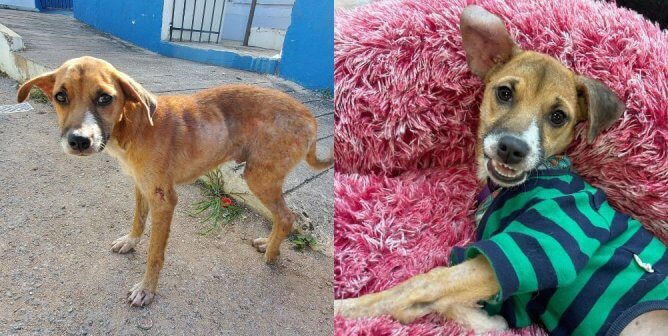
He pointed to an overturned reclining chair amid the trash, where a tiny head was sticking out ever so slightly, the puppy's reddish-brown fur almost blending in with the color of the old chair in the alley's black shadows. The stuffing had come out of the chair, allowing the dog to claim its interior as her shelter from a world that had rejected her.
Within a week of her rescue, it was obvious that the puppy—now known as "Stuffing"— was very intelligent and lovable. After a few weeks, Stuffing had gained weight, was paper-trained, and spent every night snuggled up in bed with her new human friend. Alice says that to look at her now, no one would ever guess that this happy little girl spent the first months of her life eating from trash cans and sleeping inside an overturned chair in a dark alley.
Most people don't think that the problems of strays and chained "backyard" dogs have anything to do with them. But they do. The biggest nightmare plaguing domesticated animals in our society does not involve the wanton acts of violence directed toward them by cruel humans. Rather, it involves thoughtlessness by otherwise intelligent and caring people who simply do not understand what or who dogs and cats really are, and what they need to thrive.
Want to read the rest of Ingrid's new book? You can order your very own copy at PETACatalog.com. In the meantime, you can find out what you can do to help strays and other neglected and abused animals here.
Written by Alisa Mullins
If you have a general question for PETA and would like a response, please e-mail Info@peta.org. If you need to report cruelty to an animal, please click here. If you are reporting an animal in imminent danger and know where to find the animal and if the abuse is taking place right now, please call your local police department. If the police are unresponsive, please call PETA immediately at 757-622-7382 and press 2.
Follow PETA on Twitter!